
Table of contents of the article:
The October 21, 2026, PHP vulnerabilities CVE-2026-109618 and CVE-2026-109619 highlighted a problem that many companies are aware of but tend to ignore: websites and applications still running on unsupported PHP versions. We first discussed this by describing how the PHP2Shell issue developed , then by explaining how Remi's repository pushed the fix up to PHP 7.4.
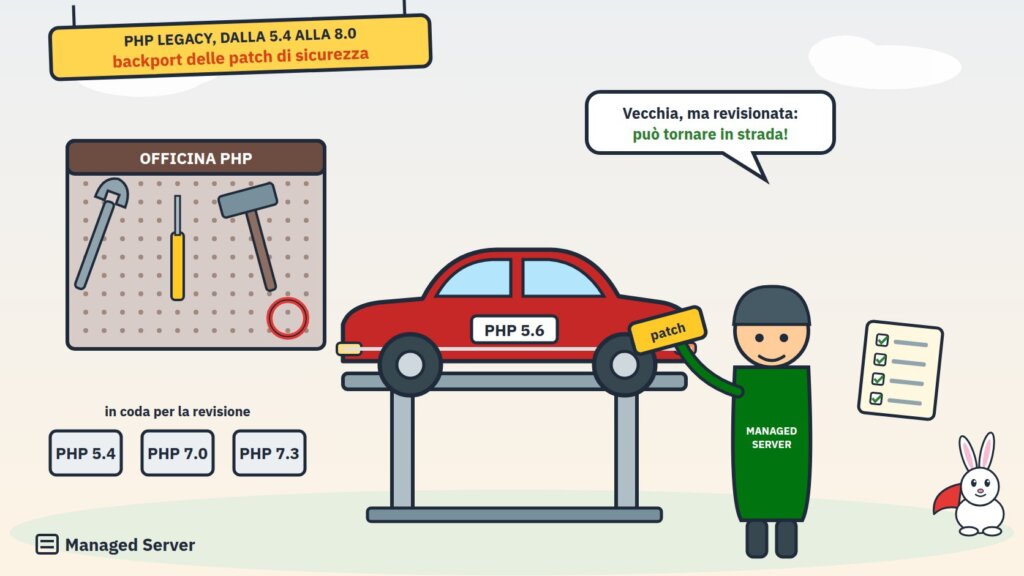
However, one question remains unanswered these days: what should those who still have PHP 5.4, 5.6, 7.0, 7.1, 7.2, or 7.3 in production, or those using PHP 7.4 and 8.0 on systems where there's no patched package, do? For these situations, Managed Server offers a PHP security patch backporting service : we backport the fixes to versions that no longer receive them, allowing you to continue using them more securely while you calmly plan your migration.
The problem with legacy PHP systems
Each PHP version has a specific life cycle: a few years of active support, then a period of security fixes only, then the end. Currently, the PHP project only supports branches from 8.2 onwards. Everything before that is officially abandoned.
In the real world, however, old versions are everywhere:
- management and vertical software developed years ago, of which often no one has the source code or the original developer anymore;
- e-commerce on outdated versions of Magento, PrestaShop or OpenCart, with customizations that don't work on new versions;
- WordPress or Joomla sites with outdated themes and plugins, which break at the first PHP version change;
- intranets, company portals, reserved areas and integrations with external systems that “work and nobody wants to touch”;
- applications that require months of work and a significant budget to be rewritten or adapted.
Until something happens, an outdated version of PHP seems like a theoretical problem. Then a critical vulnerability, exploitable remotely and without authentication, arrives, and the problem becomes real overnight.
What happened with CVE-2026-109618 and CVE-2026-109619
The two vulnerabilities patched on October 21st allow unauthenticated remote code execution, meaning an attacker can execute commands on the server without an account. They affect all PHP installations serving web requests, and the attack code was already public before the patches were released.
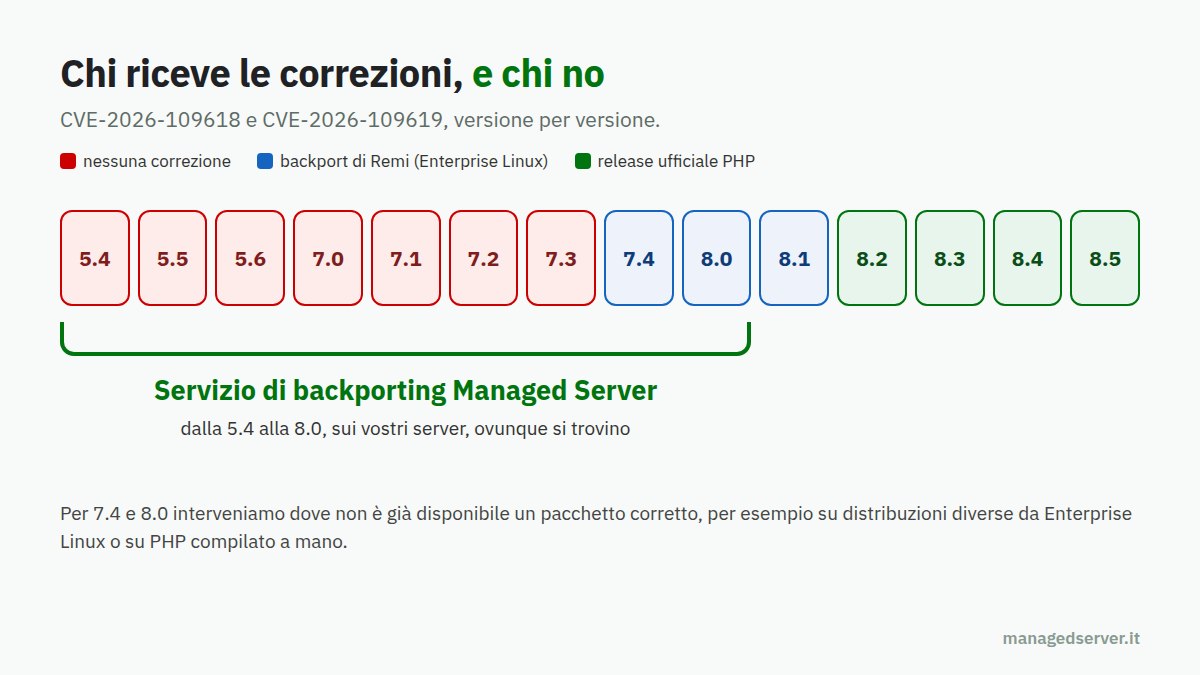
Official fixes have arrived for PHP 8.2, 8.3, 8.4, and 8.5. For PHP 7.4, 8.0, and 8.1, the PHP security team has made a minimal source fix available, which the Remi repository has packaged for Red Hat, AlmaLinux, and Rocky Linux. For all previous versions, from PHP 5.4 to PHP 7.3, there are no fixes available : neither from the PHP project nor from the main repositories.
Anyone who has a site on PHP 7.2 or 5.6 today has three options: migrate quickly, accept the risk, or rollback the fix to their version.
The cost of doing nothing
Leaving a site running on a vulnerable version of PHP, hoping no one will find it, is almost always a losing gamble. Attacks on vulnerabilities like this aren't targeted: they're automated scans that scan millions of addresses, looking for any server that responds appropriately. You don't have to be an attractive target; you just have to be reachable.
The consequences of a compromise extend far beyond the website itself: stolen customer data, subject to GDPR notification requirements; the server being used to send spam or attack other systems, with the IP address being blacklisted and company email being stopped; the website being flagged as dangerous by browsers and search engines; days of downtime to clean, rebuild, and restore. These costs almost always far exceed those of a preventative intervention.
What is patch backporting?
Backporting a patch means taking a fix written for a recent version of the software and adapting it to an older version. It sounds simple, but it's not: the PHP engine changes a lot between branches, and a fix written for PHP 8.2 almost never applies out-of-the-box to PHP 7.2 or 5.6 code. You need to understand what fixes it, find the equivalent point in the older code, rewrite the change while respecting the structure of that version, and then verify that it actually works.
This is the same job done by the large vendors of Linux distributions with long-term support, who maintain versions of PHP and other software for years well beyond their official end, only rolling back security fixes.
Managed Server PHP Backporting Service
Our service is aimed at those who use PHP versions 5.4 to 8.0 and need to continue doing so for a period of time, without being exposed to critical vulnerabilities. Specifically, we handle:
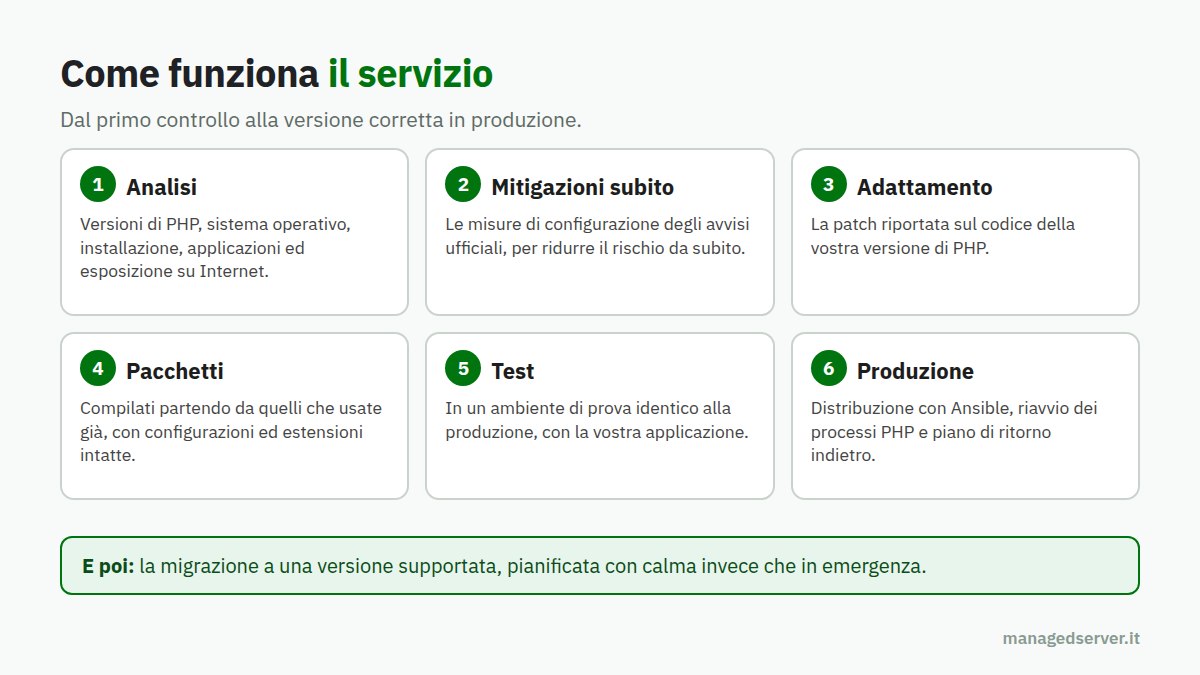
- situation analysisPHP versions in use, installation method, operating system, applications involved and their exposure on the Internet;
- patch adaptation to your version of PHP, starting from the official fixes and those already reported on the most recent branches;
- compiling packages starting from the ones you already use, for example the RPM packages from the Remi repository, keeping configurations and extensions intact;
- test in a test environment as identical as possible to production, with your real application;
- distribution in production in a controlled and automated way with Ansible, with restarting all PHP processes and a rollback plan in case of problems;
- configuration mitigations indicated by official notices, applied where the correction alone is not enough.
The result is that your website or application can continue to run on the version of PHP it was written for, with the vulnerability fix applied.
Who is it useful for?
The service is designed for companies and professionals who find themselves in one of these situations:
- they have a critical application on PHP 5.x or 7.x and can't stop it for an emergency migration;
- they are already planning the migration, but they need a few months to complete it in an orderly fashion;
- they manage many sites on different versions of PHP and want to secure them all in a single coordinated effort;
- use PHP 7.4 or 8.0 on systems for which a fixed package is not available;
- They have third-party software that the vendor no longer updates and that cannot be replaced anytime soon.
What Backporting Does, and What It Doesn't Do
We prefer to be clear, because this is a topic where clarity is worth more than any commercial promise.
The backport fixes the vulnerabilities it was created to address , such as CVE-2026-109618 and CVE-2026-109619, and significantly reduces the risk of compromise associated with those flaws. It's a serious solution, the same one adopted by enterprise distribution vendors.
Backporting doesn't turn an old version into a supported version . PHP 5.6 remains PHP 5.6: it doesn't receive improvements, it doesn't benefit from all the fixes accumulated over the years in subsequent branches, and any new critical vulnerabilities will require a new fix. That's why we consider it a bridge solution: a way to immediately secure what can't be migrated immediately, and to address the migration at the right time rather than as an emergency.
When the time comes, we can also help you migrate to a supported PHP version : compatibility analysis, test environment with the new version, bug fixes, and deployment to production.
Why rely on Managed Server
Backporting a security patch is a delicate task: it requires knowledge of the PHP engine, package building, production server management, and the responsibility of touching systems that must not be down. It's our daily work: we manage dedicated servers and infrastructures with dozens of different PHP versions, provide Linux system support on Red Hat, AlmaLinux, and Rocky Linux systems, and automate system patching with Ansible.
We don't ask you to migrate your site to us to offer you the service: we can also intervene on your servers, wherever they are located, in agreement with whoever manages them currently.
FAQ
Which PHP versions are backported for?
For versions from 5.4 to 8.0, including PHP 5.6, 7.0, 7.1, 7.2, 7.3, and 7.4. For PHP 7.4 and 8.0, we intervene when the correct package is not already available on your system.
Do I have to change my hosting to use the service?
No. We can work on your servers, even if they are managed by another provider, in agreement with the responsible party.
Does the backport slow down the site or change the behavior of the application?
The fix targets the vulnerability and doesn't affect the normal functioning of PHP. Therefore, each package is tested with your application before going into production.
Can I stay on my PHP version forever with the backport?
No, and that's fair to say. Backporting protects against fixed vulnerabilities, but the definitive solution remains migrating to a supported version. We'll help you plan it with the right timing.
How long does it take to get the correct version?
It depends on the PHP version, how much the code deviates from the correct branches, and the complexity of the environment. After the initial analysis, we'll provide you with a clear time estimate and, in the meantime, immediately apply configuration mitigations that reduce exposure.
What happens if a new critical vulnerability is released?
Every new vulnerability affecting your version requires evaluation and, if necessary, a new backport. We'll discuss this together based on your needs.
Contact Us
If you have websites or applications running PHP 5.4 to 8.0 and want to secure them against CVE-2026-109618 and CVE-2026-109619 without having to resort to an emergency migration, let's talk. We'll analyze your situation, clearly explain what can be done, how long it will take, and the limitations, and help you protect today what you'll migrate tomorrow.

