

Table of contents of the article:
I read a press release from an Italian hosting company, our competitor, which, in its new website announcement, describes an artificial intelligence crawler exploring the filters of a catalog. The store, we're told, had to compute "practically infinite pages" each time. Then comes the commercial solution: either stop the bot or serve it pages from the cache, through a service called iWebLab Cache Pro. The problem is described as enormous; the commercial solution, however, is presented without explaining the conditions that make it effective.
This simplicity irritates me because it treats complexity as something to be hidden when it comes time to sell . Readers might be convinced that simply enabling caching will solve the problem just described. But a technical possibility doesn't become a proven solution simply by tacking on a reassuring name. Conditions, measures, and results are needed. Without these elements, it remains a promise, misleading advertising, and the store will pay the price for any failure.

I'm tired of seeing complex problems packaged as opportunities to sell a reassuring label, for advertising, or publicity. Those who actually work on these systems know how many conditions are hidden behind a quick response. Those who buy hosting often don't know those conditions. This difference in expertise should require even greater clarity from salespeople. When it's exploited to imply that a feature automatically solves any load, the communication becomes, in my opinion, a mockery of the customer's intelligence. And those in the know have a duty to challenge it, demanding precise evidence before an overly facile promise becomes an operational problem paid for by someone else.
The tale of the "two roads": the customer does not have to finance the bot
In the case of a crawler that consumes resources exploring filter combinations with no proven utility for the store, no two options should be presented as equal. There's one priority: protecting the customer's business. Putting blocking and a caching service on the same level, as if they were two equivalent solutions, creates a false business alternative.
Two technically possible interventions don't automatically make sense. Nor do they exhaust the available options: you can restrict access to filters, limit the rate of requests, eliminate useless combinations, and leave valuable pages accessible. But above all, before preparing further responses for a crawler, you need to decide whether those responses are worth producing.
When a bot is harassing faceted navigation, generating new and expensive requests with no proven return, the sensible operating practice is to block or limit that behavior and leave resources to real users . First, secure the store, then evaluate any useful access. The merchant pays for the infrastructure to sell products, enable searches, update carts, and fulfill orders. They don't pay to make their database available to anyone who decides to empty their catalog.
Presenting the ability to continue feeding that traffic as a virtue, without demonstrating the benefits, is a reversal of priorities. The crawler obtains the data, the server supports the work, the customer pays for the resources, and the hosting provider provides its service. Where would the advantage for the merchant be in this story?
Caching can reduce the cost of reusable requests. It doesn't turn a useless task into a profitable one. If the bot keeps asking for new combinations, someone else will still have to produce those results. Adding a cache doesn't eliminate this responsibility and doesn't automatically justify maintaining access.
Hosting should protect the client's resource budget . The client shouldn't fund a crawler just to give the provider a chance to show off how good it is at serving them. The "Pro" label doesn't make a choice professional if it hasn't yet demonstrated any benefits for the payer.
Training other people's AI is not a business advantage!
A training bot collects content to help develop a model. This activity alone doesn't guarantee the store visits, mentions, orders, or improved visibility . Serving thousands of catalog combinations to that bot isn't considered marketing because the acronym "AI" appears in the description. Without a documented return, the cost is tangible and the commercial benefit remains unproven.
It's particularly difficult to justify that cost when it comes to crawlers from Chinese companies collecting data for their models, without a proven return channel to the Italian store. A concrete example is Bytespider: Cloudflare attributes it to ByteDance, the Chinese company that owns TikTok , and includes it in the category of AI training crawlers . Citing this category is pertinent; attributing the screenshot case to that bot would be another matter, because the crawler is not identified in the announcement.
This very omission deserves an answer: who was the bot, what activity was it performing, and what benefit was it providing to the customer? Writing "an AI assistant" isn't enough. The customer isn't obligated to pay for processing on their catalog to contribute free of charge to another company's model. This applies to a Chinese, American, or European company: the cost of its training doesn't become a requirement of the store.
Even the names Claude, Gemini, and OpenAI aren't a catch-all. Functions need to be distinguished. OpenAI distinguishes GPTBot, intended for collecting content usable for training, from OAI-SearchBot, intended for search . Anthropic distinguishes ClaudeBot from Claude-SearchBot and user requests via Claude-User . For Google, Google-Extended controls usage for training and grounding Gemini, without determining inclusion or ranking in Google Search.
Access tied to a user's search or request can be valuable. Crawling for training is a different option. And even a well-recognized search bot doesn't need to explore every combination of filters without limits. Useful products and categories can be made available, protecting the parts of the catalog that merely generate traffic.
If the return isn't there or isn't demonstrated, the resource-consuming behavior stops. The merchant isn't told he must continue to support it to stay modern. His store must serve customers. Everything else must justify its cost.
The crucial question: What happens when the page is not cached?
I want to know what happens to requests that arrive when that page, in the cache, does not yet exist.
That's where the quality of the solution is measured. That's where the database, the application, and the search system work. That's where a store can slow down while a real customer searches for a product and tries to buy it.
A cache preserves a previously obtained result for reuse. If one hundred compatible requests request the same page while the copy remains usable, the benefit can be enormous. If one hundred requests request one hundred different pages, all of which are missing from the cache, those one hundred responses still need to be produced. The potential benefit of other cache levels must be evaluated separately.
This distinction should appear alongside the promise, with equal prominence. Because a crawler systematically traversing different combinations can produce precisely that second scenario. It changes color, size, material, category, sorting, page. Each request can identify a new result. And each new result can mean additional backend processing, meaning CPU, RAM, bandwidth, and a slow or, worse, offline server.
How much is actually reused before expiration? That is the question.
Product Variants and Filtered URLs: Counting the Right Stuff
Let's consider an example with a thousand T-shirt models, ten colors, and seven sizes. The product is correct: 1.000 × 10 × 7 = 70.000 theoretical variations . Adding two more filters, such as three necklines and three materials, all available and combinable, we arrive at 630.000 variations.
I want to be clear about this: product variations don't automatically match the URLs in faceted navigation. A color and size filter can display dozens of T-shirts at once. A thousand styles don't necessarily increase the number of filtered pages.
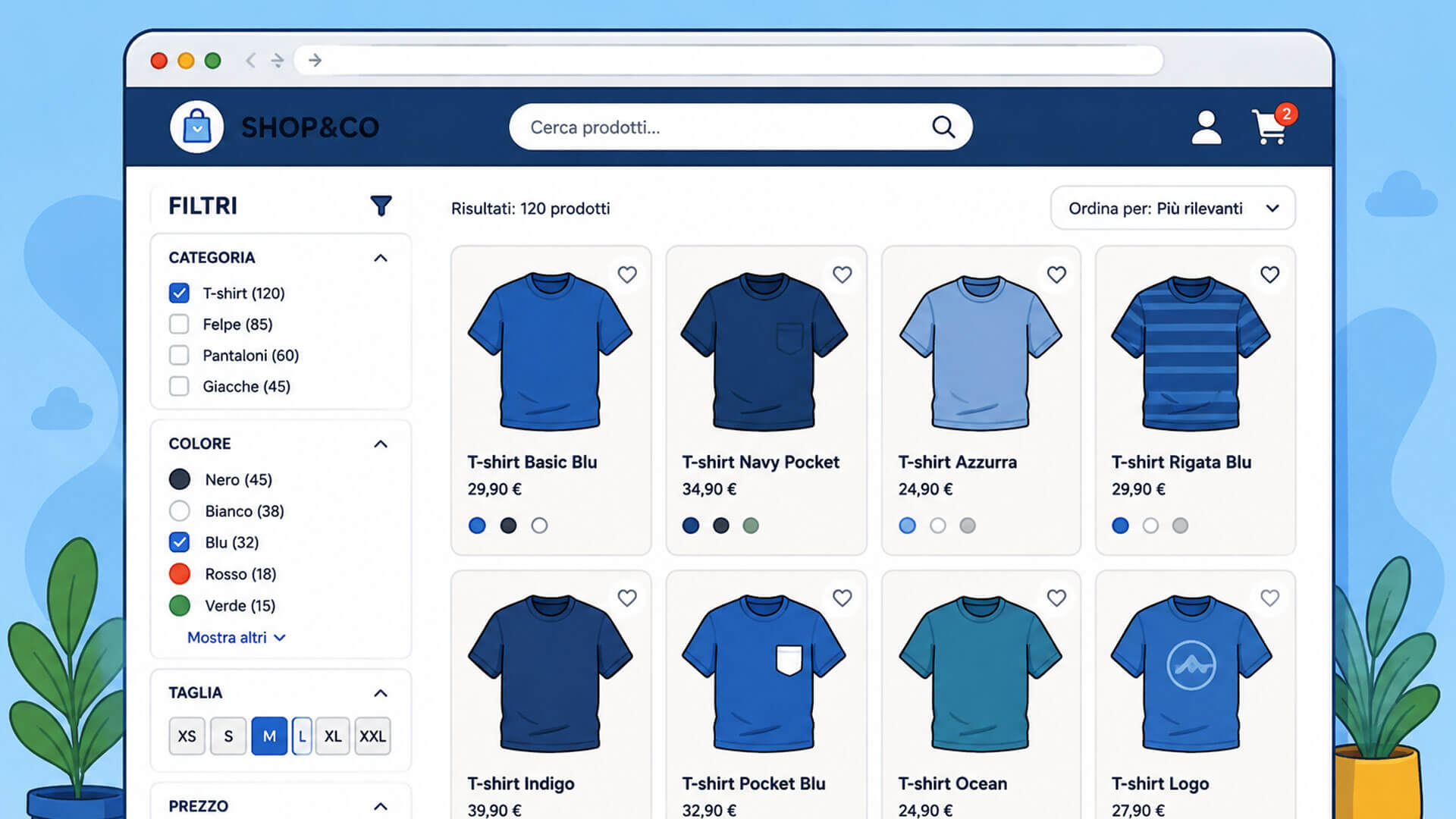
With four mandatory filters, choosing only one value for each, ten colors, seven sizes, three necklines, and three materials yield 630 complete filter combinations. The count changes when filters are optional, allow multiple selections, or add categories, pagination, and sorting. Combinations with no results should not be treated as useful pages.
A technical critique must distinguish these numbers. I'm interested in a discussion that stands up to scrutiny, starting with the examples used to explain the problem.
Preheating has a cost, even before the bot arrives
If a catalog actually exposes 70.000 distinct URLs to preheat, at ten generations per second it would take one hour, fifty-six minutes, and forty seconds. If it exposes 630.000, it would take seventeen hours and thirty minutes . These are arithmetic calculations, based on hypothetical speed, not benchmarks for the service shown in the screenshot.
Ten pages per second may be too little or too much: it depends on the cost of the queries, the application, the indexes, the platform, and the available resources. However, those who propose this strategy should declare the speed it supports on the actual catalog, along with the load it leaves available to users.
Moving a processing step to a scheduled stage can be an excellent choice. It allows you to control the pace and utilize favorable windows. However, this choice must be factored into the service's sizing. The merchant is paying for resources that will also support cache preparation, in addition to visits and purchases.
Pricing and availability change: how do I update my cache?
And then the catalog changes. Prices, availability, promotions, products, and visibility rules change. Some updates affect just a few pages; others can involve many combinations. Selective invalidation can help enormously, if designed well. This is precisely why I insist it be explained, rather than left hidden behind a generic "we serve from cache."
To understand the order of magnitude, keeping 630.000 pages fully updated every hour would require an average of 175 generations per second. This is an assumption of complete regeneration, not a universal requirement. But it highlights the importance of update frequency and invalidation selectivity.
Disk space, on the other hand, could be relatively modest. Assuming ten kilobytes per response, 630.000 responses are worth approximately 6,3 gigabytes of content, before overhead. That number alone doesn't demonstrate any technological impossibility.
The challenge is producing, updating, and reusing responses within the available resource budget. Confusing the ability to store a few gigabytes with the ability to efficiently maintain a catalog under aggressive crawling is missing the most important part of the discussion.
Hits, misses, and user times: the numbers to show
So, before we tell you we've solved the problem, let's show the HIT rate for just the faceted pages requested by that crawler. We'll show MISSES per second, query costs, database load, and user response times during exploration.
The aggregate data for the entire site may hide the very problem we are discussing.
I want to see what happens on the crawler's first pass, with the cache cleared, and on subsequent passes. I want to see what happens after a catalog change. I want to know how many different URLs are requested and how many receive a second visit while the copy is still usable.
This is verifiable data. "Cache Pro" is a marketing name. A marketing name isn't a technical answer and isn't a substitute for a benchmark.
Stopping unnecessary crawling is protecting the customer
Google, in its documentation on faceted navigation , recommends preventing the crawling of filtered URLs that don't need to be indexed. When they do need to be crawled, it recommends carefully managing URL structure and non-resulting combinations. It also emphasizes that crawling useless pages can slow down the discovery of useful content.
These guidelines apply to Google. An AI crawler can have different purposes and behaviors. For each bot, it's necessary to decide what to make accessible, at what rate, and with what expected benefit. Furthermore, a rule in robots.txt depends on the crawler's compliance; effectively controlling requests may require server or security measures.
The shop owner has every right to ask whether that exploration is beneficial to their business. They also have the right to limit it, without being told that the most advanced option is necessarily to purchase an additional service to support it.
If the bot continues to generate new, expensive, and useless requests, restricting access to filters or stopping the behavior may be the most sensible decision. This can leave useful product pages and categories available: the control can be selective.
An unproven promise does not become true because it sells well.
My position is clear: serving filtered pages from the cache can be effective when there is sufficient reuse and the cost of generation and updating is sustainable. A limited set of combinations or selective pre-warming can help; there is no universal product threshold or magic one-hour duration. Hybrid strategies also exist. Precisely because I am aware of these possibilities, I find it unacceptable to present them without explaining the conditions that determine the outcome.
The phrase "practically infinite pages" doesn't provide a count. It doesn't reveal how many distinct URLs exist or how long it takes to generate them. But if it's used to support a business case, then those numbers should be published. With millions of expensive URLs, warming up could take days or weeks; under other conditions, it could be much quicker. Describing a problem as enormous and withholding the data needed to verify its solution is a sales pitch I don't accept.
In my opinion, from a commercial perspective, such a communication comes dangerously close to misleading advertising. It presents a technical solution as a response to a huge problem, without providing the data that would allow us to understand whether that solution holds up. I'm not just claiming that the service doesn't work; I'm also challenging a promise that, in the information provided, isn't proven. If the intended message is that the cache renders any sequence of new combinations harmless, that message is technically false . A response missing from the cache still needs to be produced: the name of the product doesn't change that fact.
Before purchasing, the customer should be able to know which results are demonstrated, on which catalog, with what update frequency, and under what load. They should also know how the service behaves when traffic exceeds those conditions.
Hosting sellers should know how to answer these questions. Especially when they use a real problem to promote their product.
In Managed Server we have customers who also manage catalogs with 2 million SKUs.
This experience leads me to ask about numbers, request distribution, and processing costs. The number of products alone isn't enough; a small catalog can be poorly queried, while a very large one can be well-designed.
I find this reassuring tone a mockery of the client's intelligence. For those unfamiliar with HITs, MISSES, invalidation, and query costs, a convenient formula is offered, while all the inconvenient conditions are left out of the story. In the eyes of those who actually manage these systems, the high-sounding name means nothing if the measurements are missing. The supposed Holy Grail of web performance must overcome a very banal question: what happens when the result doesn't exist yet?
The complexity that disappears from the message remains on the customer's server. It remains in queues, queries, and the time it takes a person to complete a purchase.
If you've built an effective solution, demonstrate it under the challenging conditions you're citing. Publish a reproducible case study, with enough data to understand what protects the backend and what continues to cost it work.
Until then, the phrase "practically infinite pages" coupled with the promise of serving them from the cache raises some very uncomfortable questions and conclusions that can only end with "false advertising!" Every answer has a production cost, a useful lifespan, and a probability of reuse. Whoever sells the solution must make these three elements visible.
The customer pays to have a functioning store, not to finance the crawling of others and appear as an extra in a commercial promise.
If you have a solution, show the results. If you only have a reassuring formula, stop presenting it as if it were sufficient to neutralize the problem. The conditions you omit from the ad don't disappear: they remain on the server, and the customer keeps the bill.
Marco Marcoaldi — CTO of Managed Server Srl

