

Table of contents of the article:
Since Google forced the almost mandatory switch to HTTPS in 2018 , there have been changes among hosting providers who have been unable to make some caching technologies work because they do not comply with the new HTTPS protocol.
In truth, what has been seen quite clearly is a transition from the good old and high-performance Varnish to the new LiteSpeed + LSCache.
Many Hosting companies continued to position themselves with keywords praising Hosting Varnish, Varnish Performance and similar but then in the end they palmed off Hosting with LiteSpeed and LSCache.
On Facebook groups, Newsgroups and similar, almost religious wars broke out , between those who showed biased benchmarks of Litespeed and those who showed numbers and statistics obtained with Varnish Cache and between professional Hosting that even advised against Varnish as it was dangerous with complex Cache management as reported in the obviously censored screenshot.

It must be said that Cache Varnish management must be configured by a professional system administrator with experience with these technologies and significant impacts on other technologies such as AMP pages, Sitemaps, Instant Articles and so on, but advising against something just because you don't know how to use it or are unable to configure an automated and selective cache cleaning system, going so far as to think that there must be " a little man who manually clears the cache every time ", says a lot about how disastrous the hosting sector is in Italy and how much, albeit genuine, improvisation there is in the sector.
Varnish and HTTPS
While it is true that Varnish is absolutely not compatible with HTTPS as it lacks that "part" that allows HTTPS negotiation and cryptographic support, this lack should not be seen as a bug but rather, according to its developer, as a FEATURE as reported on the official website: https://varnish-cache.org/docs/trunk/phk/ssl_again.html#conclusion

Just because it's not HTTPS-compatible by design doesn't mean it can't be used with HTTPS. It simply requires an HTTPS/SSL terminator, such as Apache, NGINX, H2O, or HAProxy.
This evidently created a difficulty in studying some techniques and methodologies in using Varnish with HTTPS so we saw what we saw: hosting touting LiteSpeed as the best cache ever, even better than Varnish, and with fearsome performance.
We obviously have a diametrically opposed opinion: Varnish's performance and configuration flexibility are in no way comparable to the toy that is LiteSpeed. In our practice, we see users with news portals coming from LiteSpeed every day, switching to our stack with Varnish cache, and immediately finding relief as well as improved performance, rankings, and Google positioning.
That said, while impartial in intent, it can rightly be shared as a biased judgment. Let's let the numbers and statistics from sites like CNN, BBC, ESPN, Daily Mail, Forbes, USA Today, NY Times, The Guardian, Wikipedia, and sites that receive over 5 billion visits a month speak for themselves.
Do you think these sites mentioned above use Varnish or LiteSpeed?
We used the site similartech.com , which allows us to select sites based on the technology used and many other parameters, selecting sites that use Varnish. In its free report, limited to 10 records, we performed two searches: the first was generic and unfiltered, i.e., sites that use Varnish ; the other, we set the category to News and media.
Here are the results:


Two facts are immediately evident: One of the most visited sites in the world , Wikipedia, uses Varnish, one of the most visited Adult sites in the world uses Varnish, and most of the most authoritative and read news sites in the world use Varnish.
The search is obviously limited to the first 10 records offered by similartech in the free version, but we believe they are eloquent enough to demonstrate that Varnish is the market choice when it comes to working with high-traffic sites.
LiteSpeed who uses it?
Still aiming to be as impartial as possible, we used the same criteria above to perform a search on similartech.com using LiteSpeed as the keyword for the technology used. Below are the results, both for the technology itself and for the technology filtered by Industry Verticals ( News and Media ) (exactly as we did for Varnish above).


As we can see, the largest site using LiteSpeed is animeFLV and it gets 142 million visitors per month. Among the News and Media sites, on the other hand, there is no known brand like the ones mentioned above, at least known in the collective imagination as a brand like CNN or New York Times can be evocative.
LiteSpeed VS Varnish specifically
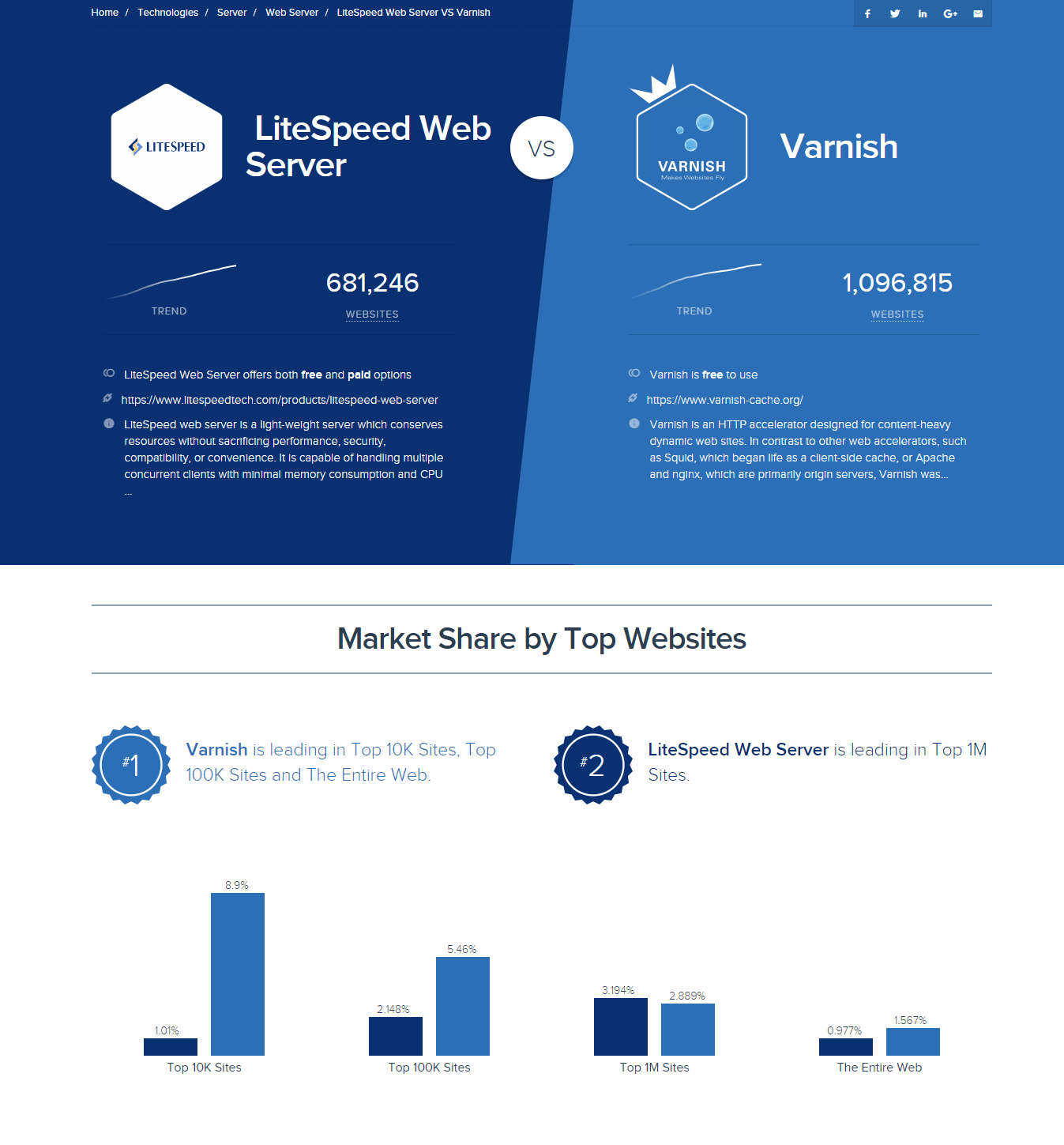
As always reported by similartech.com at this address LiteSpeed WebServer VS Varnish Varnish is the most adopted technology on the top 10 sites in the world and in the top 100. LiteSpeed is more widespread among the first million sites.
Considerations
Perhaps someone who wants to defend LiteSpeed will want to cite the famous VHS VS BETAMAX story in which a worse technology like VHS can take over Betamax, objectively better in many respects, or that LiteSpeed is too new compared to the much older Varnish.
In reality LiteSpeed was born way back in 2003 as reported by Wikipedia and Varnish even later in 2006, again according to Wikipedia.


Or you might come to think that perhaps it is because the license is commercial and therefore expensive that it is not so widespread, but it is difficult to think that publishing groups such as those mentioned above do not have a few tens of thousands of dollars a year to manage the licenses if the game is actually not worth the candle. Maybe it's really not worth it, that's all.
Conclusions
Although LiteSpeed WebServer is a performance-oriented web server with a built-in cache like LSCache, it does n't appear to be an industry standard, nor is it likely to become one. Its growing trend, as we can deduce, is due to the transition to HTTPS, which has created the problem of having a webserver with a built-in caching system as an alternative to Varnish. Since LiteSpeed is compatible with Apache's .htaccess file and its rewrite rules, it makes sense to use it as an evolution of Apache itself. A hosting provider that offers LiteSpeed to Apache is certainly more successful and will perform better than the now widespread but not very high-performance Apache.
However, it should be noted that LiteSpeed is not the market choice for high traffic and high performance sites as we have seen above.
Of course someone could always object that LiteSpeed is a WebServer and that Varnish is a static caching software, and that we should take a pure Webserver as a yardstick and comparison.
Certainly the objection has its reasons and finally let's try to compare a Web Server like NGINX with the same criteria used on similartech.com, that is, a report from those who use NGINX in the News and Media sector.

What emerges from a comparison between pure web servers like NGINX is that we find the same old names and giant brands like BBC.CO.UK, BBC.COM, FOX NEWS, NY TIMES, which suggests once again that NGINX together with Varnish are a perfect match, the pair to beat that for now dominates the market of high-traffic websites.
What do we use?
By managing portals that make tens of millions of visitors per month up to hundreds of millions of pageviews per month it is obvious and obvious that we try to constantly improve in finding and adopting the best and most performing solutions.
However, for about five years, we haven't been able to find a better software stack than NGINX, Varnish , Memcached, and REDIS.IO with ElasticSearch support for searches. Every other solution we've tested has proven largely inadequate to the stack we use and are used by the world's leading news sites.
This stack has allowed us to achieve important milestones for other important clients, including the client with 85 MILLION visitors per month (whose analytics you can see below), and another with over 33 million pageviews per month right after.

Another court-registered publishing site that generates millions of hits per month and over 30 million page views:

Do you have a high traffic site, a newspaper or a blog that requires the utmost expertise in systems and technology?
Do not let yourself be duped by many beautiful words and by marketing, entrusted by those who since 2005 host high traffic sites of the largest Italian companies using the best technologies on the market.
Contact us now!

