

Table of contents of the article:
Introduction
As performance hosting and advanced systems professionals , we've recently been witnessing a curious and worrying phenomenon: interest in website performance seems to have drastically waned, even among industry insiders. Except for the most egregious cases—those where a page takes as much as five seconds to load—in the most sophisticated situations, it almost seems as if a second more or less makes no difference.
While this attitude may seem normal to a typical user or someone without technical expertise, it becomes a red flag when web agencies, developers, and freelancers adopt this approach . Despite adopting decent solutions, they often forgo truly optimal ones. The issue becomes even more serious when these compromises involve landing pages on which tens of thousands of euros are invested in advertising campaigns : here, even a delay of just a few milliseconds can translate into a tangible loss of leads and sales.
With this article, we want to show, in a technical and impartial manner , how many agencies today are following a path that is by no means the best among those available. We will do so by using Stratego Swat , a renowned and recognized online company, as a case study, aware that this is not an exception in the Italian landscape, but rather a rule: that of underestimating a crucial factor like hosting.
Who is Stratego Swat?
Stratego Swat is an agency based in the Republic of San Marino, composed of approximately thirty professionals active in various areas of marketing, communications, and digital business. On their official website (strategoswat.com), they present themselves as a team capable of supporting companies and professionals in online growth, offering integrated solutions ranging from strategic consulting to operational campaign management.
One of Stratego Swat's distinctive features is their strong, widespread online presence : they are extremely active on the main social networks, and their targeted advertising on Instagram is particularly frequent and highly recognizable, so much so that it has become a defining element of their communication. This visibility is no coincidence, but the result of a clear and consistent approach guided directly by the founder, Giampaolo Antonante , who has given the brand a strong and highly recognizable tone.
The agency's stated approach is that of a diverse team, in which graphic designers, copywriters, social media managers, advertising experts, web developers, and strategic consultants work together in synergy. This multidisciplinary approach is undoubtedly a strength: it allows them to follow every stage of the marketing funnel, from traffic generation to lead and customer conversion, ensuring comprehensive and structured management of digital activities.
Landing pages in the business model
Among the flagship services offered by Stratego Swat we find landing pages , to which the agency dedicates a specific section of the site: “We Make Landing Pages”.
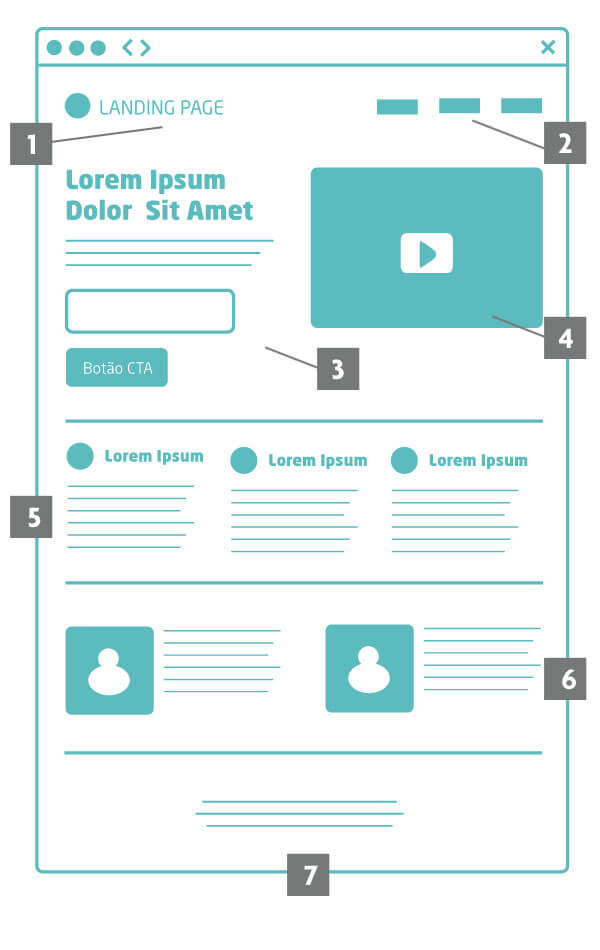
But what exactly is a landing page? It's not just a simple web page or an extension of a corporate website. A landing page is designed with a single goal : to convert a visitor into a lead or customer. It's designed to eliminate distractions and guide the user along a clear path, culminating in a specific action: filling out a contact form, purchasing a product, booking a service, or subscribing to a newsletter.
Stratego Swat's philosophy is clear: the landing page is a key component of a broader marketing machine. It doesn't exist as a standalone entity, but as a destination for traffic generated by advertising campaigns and communication activities. The agency uses Facebook Ads, Google Ads (formerly AdSense) , and other similar platforms to drive a steady flow of visitors to these pages, designed for conversion.
In their communication, Stratego Swat strongly emphasizes that a landing page should not be confused with a showcase site , which often has informational and generic purposes. A landing page is an asset that thrives on measurable objectives , where success is measured in terms of CTR (click-through rate), generated leads, sales, and actual bookings . This is a commendable vision, perfectly in line with digital marketing best practices, as it encourages us to consider each project not as a simple graphic exercise, but as a true business tool geared towards achieving a return on investment (ROI).
A critical point: the technical part and hosting
While acknowledging the value of advertising strategies and the effectiveness of landing pages as a lead generation tool, one aspect emerges that, in our opinion, could be substantially improved: the care taken with the technical infrastructure and web performance related to hosting.
Landing pages are, in fact, "high-intensity" tools: they must be fast, light, and immediate. It's not just about design or copywriting, but overall performance , which Google has long evaluated through specific metrics like Core Web Vitals (Largest Contentful Paint, First Input Delay, Cumulative Layout Shift).
These indicators, made known by Google as SEO ranking factors, are no longer a technical detail, but represent a crucial element that influences:
-
Organic positioning in the SERPs;
-
The cost of Ads campaigns (since a slow landing page increases the CPC and worsens the Quality Score);
-
Direct conversions , as several independent studies have shown how an improvement of a few tenths of a second in loading speed can reduce abandonment rates and increase conversion rates.
Customer perception and technical reality
It must be said that, according to the testimonials published by Stratego Swat on their website and social media channels, clients are consistently very satisfied with the results achieved. The reviews highlight the support received, the impact of the advertising campaigns, and the effectiveness of the landing pages in terms of graphics, copywriting, and persuasive messaging. There's therefore no reason to doubt the quality of the work done on the creative and strategic fronts.
However, it's equally true that end customers rarely have the tools to analyze what happens "behind the scenes": they don't evaluate the quality of hosting, the loading speed on mobile or desktop, or even compliance with Core Web Vitals parameters . What they perceive above all is the immediate impact: the number of leads generated, the increase in contact requests, the campaign performance compared to the investments made.
Let's take a practical example:
-
A client sees 100 contacts coming in from a Facebook campaign in a week and considers the result positive.
-
What he doesn't know is that if the landing page had faster loading times and better PageSpeed Insights scores, those same 100 contacts could have been 110 or 120, simply because some of the users wouldn't have abandoned the page while it was loading.
This creates a sort of information asymmetry : the customer focuses on the immediate result (generated leads), while Google and analytics tools highlight inefficiencies that, if resolved, would have a direct impact on both conversions and SEO.
It's precisely within this perceptual gap that lies ample room for improvement. If an agency like Stratego Swat were to combine its already well-structured marketing efforts with a performance-optimized hosting infrastructure , clients would have a twofold advantage:
-
Better results from paid campaigns , thanks to faster landing pages that reduce abandonment rates and improve the Quality Score on your ads.
-
Long-term organic growth , because Google rewards pages that offer a superior user experience and meet Core Web Vitals parameters.
In other words, it would not only be a matter of providing "beautiful and convincing" landing pages on which to invest significant advertising budgets, but also technically impeccable ones , capable of transforming momentary satisfaction into a lasting competitive advantage thanks also to the better ranking and positioning that a site that meets Google requirements can achieve and guarantee even in strategies in which latent demand is intercepted (i.e., direct demand in search engines), without necessarily being dependent on push strategies that require constant and continuous investment in terms of display advertising and campaigns.
Why hosting makes the difference
Hosting isn't just a "container" for a landing page: it's the foundation that determines whether the user will have a seamless experience and whether the marketing campaign will achieve the desired results. A page built with the best design and persuasive copywriting risks failure if the server is slow , the configuration isn't optimized, or if an adequate caching layer is missing.
It's true that in ideal settings—such as a stable fiber optic connection or the latest generation of 5G —certain gaps may be less noticeable. However, the daily reality of many users is different. Consider a radio connection like those offered by operators like EOLO in Italy: on rainy or cloudy days, the signal quality drops dramatically, and even a website with non-optimized loads becomes difficult to use. The same happens with intermittent 4G connections , common in rural areas of the Apennines or on islands, with Sardinia being a prime example. In these scenarios, every technical inefficiency is amplified: a slow server or a poorly optimized page can become an insurmountable obstacle.
From Google 's and users' perspective , a slow page equals a bad experience, and the data speaks for itself:
-
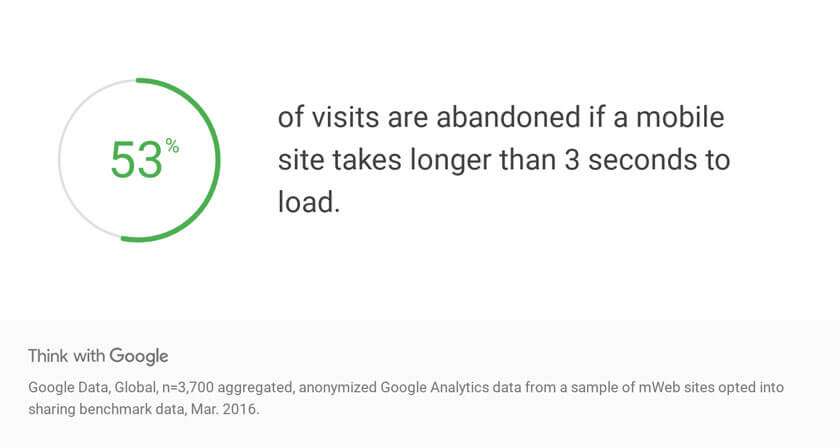
53 % of mobile users abandon a site that takes more than 3 seconds to load (source: Google).
-
Just one extra second in load time can reduce conversions by up to 20%.
-
Improving technical performance means more trust, greater interaction, and a better return on investment.
This is why hosting isn't a technical detail for engineers, but a strategic business choice . A fast, scalable, and resilient infrastructure not only reduces the cost per conversion in advertising campaigns and improves SEO rankings, but also ensures a consistent experience regardless of connectivity conditions. In other words, it makes the page reliable not only for those browsing from Milan with 1 Gbps fiber optics, but also for those connecting from a small Apennine village with an inconsistent mobile connection.
Practical analysis: the tested sites
To better understand Stratego Swat's modus operandi and evaluate the impact of their technical choices, we decided to conduct concrete measurements on some of their most representative websites. The goal isn't to question the quality of their marketing strategies—which, as we've seen, are well-structured and well-received by customers—but rather to highlight a common technical thread , tied to web performance and hosting infrastructure.
In particular, we analyzed the following projects:
-
The official website of Stratego Swat : www.strategoswat.com
-
The website of LEGGE3 , a leading company dedicated to over-indebtedness solutions: www.legge3.it
-
The Sharknet website , specializing in mosquito nets and protection systems: www.shark-net.com
-
The Alter Formazione website , which offers professional training courses: www.alterformazione.it
-
The website of Oro Etic , a company active in the gold and jewelry sector: www.oroetic.it
These sites represent a significant sample of the agency's digital output, both for the variety of sectors involved (training, design, legal consulting, consumer goods, luxury goods) and for the online visibility they have acquired.
Our analysis focused on some key parameters:
-
Loading speed , both on desktop and mobile;
-
Core web Vitals (Largest Contentful Paint, Interaction to Next Paint, Cumulative Layout Shift);
-
Infrastructure stability and consistency (hosting choices, caching, compression, resource management);
-
Image optimization is a key aspect that directly impacts the visitor's experience.
This analysis isn't intended to judge the content or creativity of the projects, but rather to determine whether there's a recurring pattern in the technical choices and whether there's real room for improvement in terms of hosting and web performance.
And the preliminary results, as we'll see later in this article, paint a clear picture: despite the quality of the campaigns and the thoughtful design of the pages, there are obvious technical shortcomings . These shortcomings, while not immediately compromising the results perceived by customers, could limit the overall potential of the landing pages in terms of:
-
Technical SEO , with an impact on organic positioning;
-
Cost of paid campaigns , due to lower quality scores in Ads;
-
User experience and conversion rate , especially in contexts of weak or unstable connectivity.
At the same time, this picture highlights enormous potential for improvement : by adopting high-performance hosting solutions and technical optimization strategies, return on advertising investment and organic growth could benefit significantly.
Analysis of the first site: Stratego Swat (https://www.strategoswat.com)
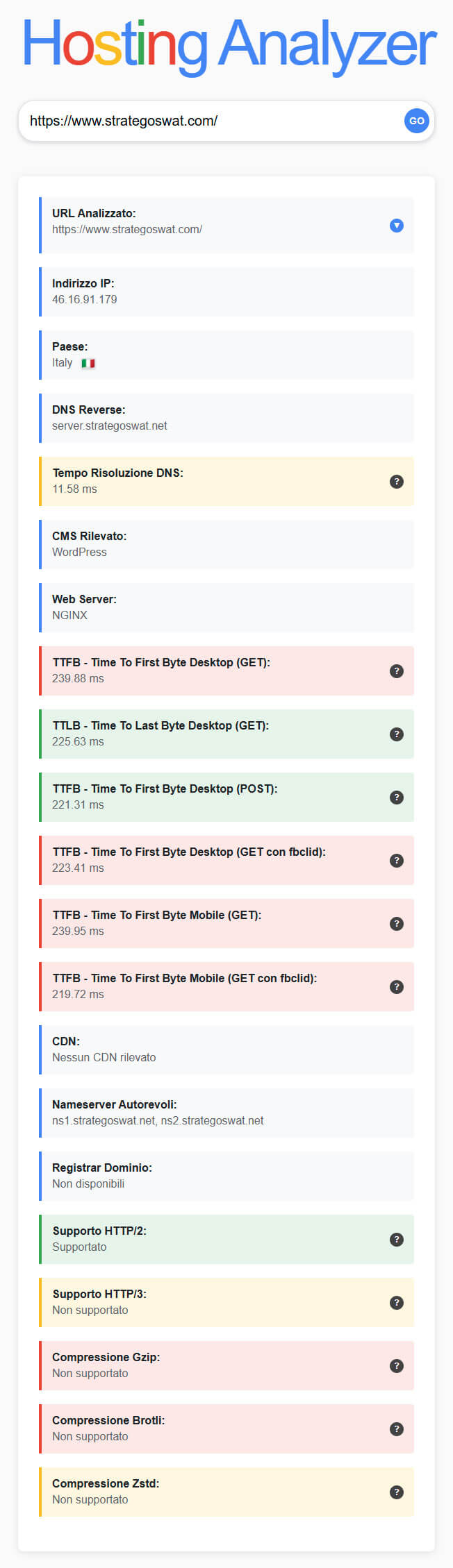
Checks performed with tools like Hosting Analyzer and Google PageSpeed Insights provide a pretty clear picture of the current state of the site.
1. Hosting and server configuration
-
CMS detected : WordPress
-
Web server : NGINX
-
HTTP/2 support : active
-
HTTP/3 Support : Not Active
-
Compression : No compression is active (neither Gzip, Brotli, nor Zstd). This results in a higher data volume transmitted and therefore slower page loading, especially on less-than-optimal networks.
DNS resolution time ( 11,58 ms) is decent, but Time To First Byte (TTFB) values are above Google's recommended threshold.
-
Desktop: ~239 ms
-
Mobile: ~220–240 ms
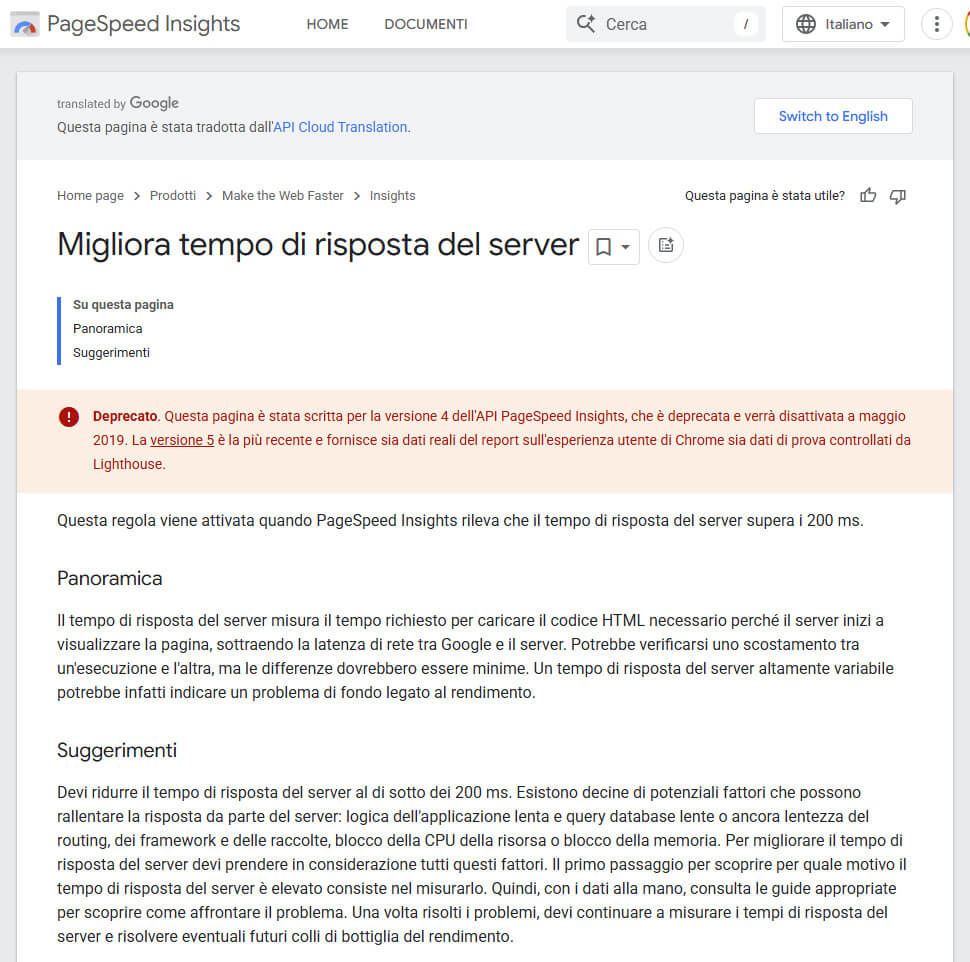
Google indicates 200 ms as the maximum recommended TTFB value . Exceeding this threshold means the server's initial response is already delayed, and every further page loading phase is penalized.
2. PageSpeed Insights
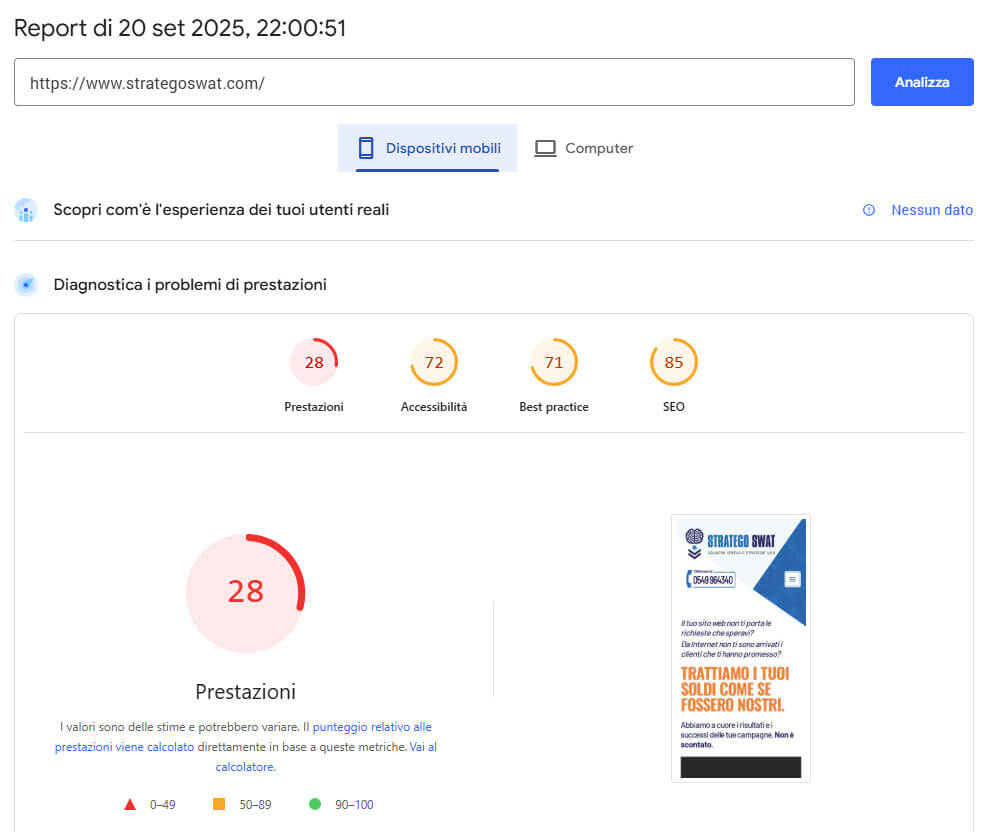
Google's mobile analysis highlights important critical issues:
-
Performance : 28/100 → very low score, red band.
-
Accessibility : 72/100 → fair but room for improvement.
-
Best practices : 71/100 → reports suboptimal technical implementations.
-
SEO : 85/100 → above average, but not excellent.
The mobile performance score is the most critical metric, because most of the traffic today comes from smartphones.
3. Core Web Vitals
Actual Core Web Vitals data from the Chrome User Experience Report isn't available . This happens when the site doesn't generate enough traffic tracked by Google to provide reliable statistics.
However, lab simulations suggest that there may be issues with LCP (Largest Contentful Paint) and INP (Interaction to Next Paint) , both key user experience metrics and official ranking factors.
4. General considerations
From an impartial perspective, the points can be summarized as follows:
-
The technological basis is valid (WordPress on NGINX), but the configuration is not optimized on the hosting side.
-
The lack of compression and exceeding the 200 ms TTFB threshold recommended by Google are clear critical issues.
-
The lack of real data on Core Web Vitals prevents a definitive assessment, but tests already indicate inefficiencies that impact SEO and conversions.
5. Practical implications
The site may be usable under fast connection conditions (fiber, stable 5G), but the limitations become very penalizing in less favorable contexts, such as:
-
Radio connections (EOLO and similar), which worsen significantly on rainy or cloudy days;
-
Unstable mobile coverage (intermittent 4G), common in rural or island areas such as Sardinia.
In these scenarios, a TTFB already above 200 ms makes the user experience even slower, increasing the risk of abandonment and reducing the effectiveness of advertising campaigns.
Analysis of the second site: Law 3 (https://www.legge3.it)
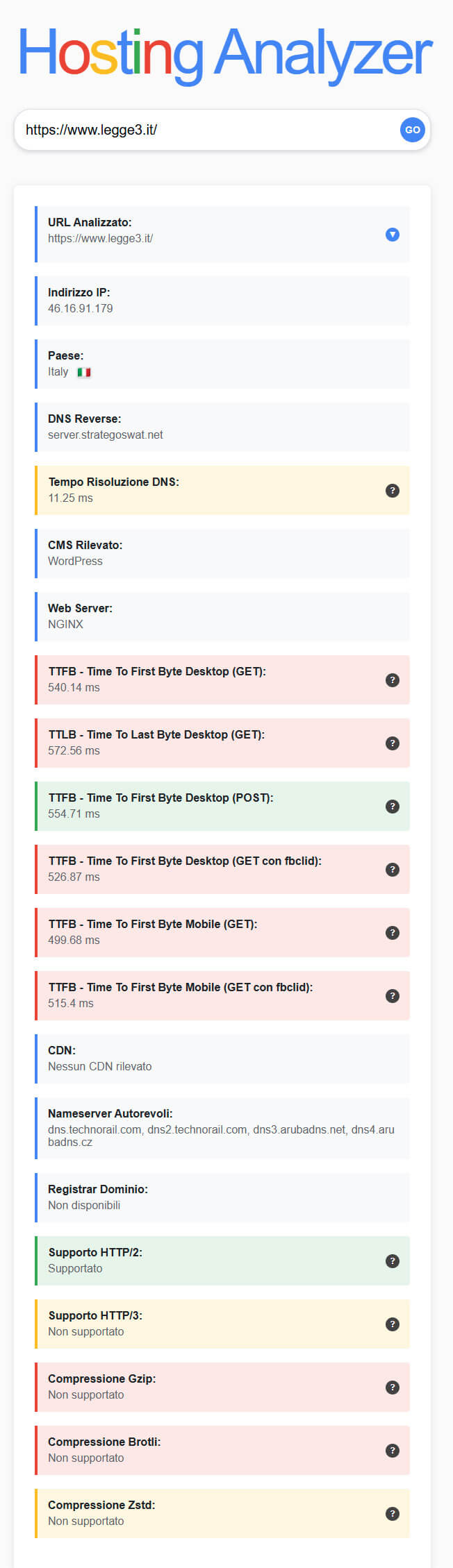
Checks using Hosting Analyzer and Google PageSpeed Insights provide a fairly clear picture of the site's performance and technical health.
1. Hosting and server configuration
-
CMS detected : WordPress
-
Web server : NGINX
-
HTTP/2 support : active
-
HTTP/3 Support : Not Active
-
Compression : No compression (Gzip, Brotli, Zstd) is enabled. This increases the overall size of the transferred resources and slows down loading, especially on mobile devices or slow connections.
Time To First Byte (TTFB) values are very critical:
-
Desktop : ~540 ms
-
Mobile : ~500–520 ms
These values are more than double the maximum threshold recommended by Google (200 ms) . In practice, the server takes too long to return the first response to the browser, negatively impacting all subsequent metrics.
2. PageSpeed Insights and Core web Vitals
Unlike strategoswat.com, this site has real-world data collected from the Chrome User Experience Report (CrUX).
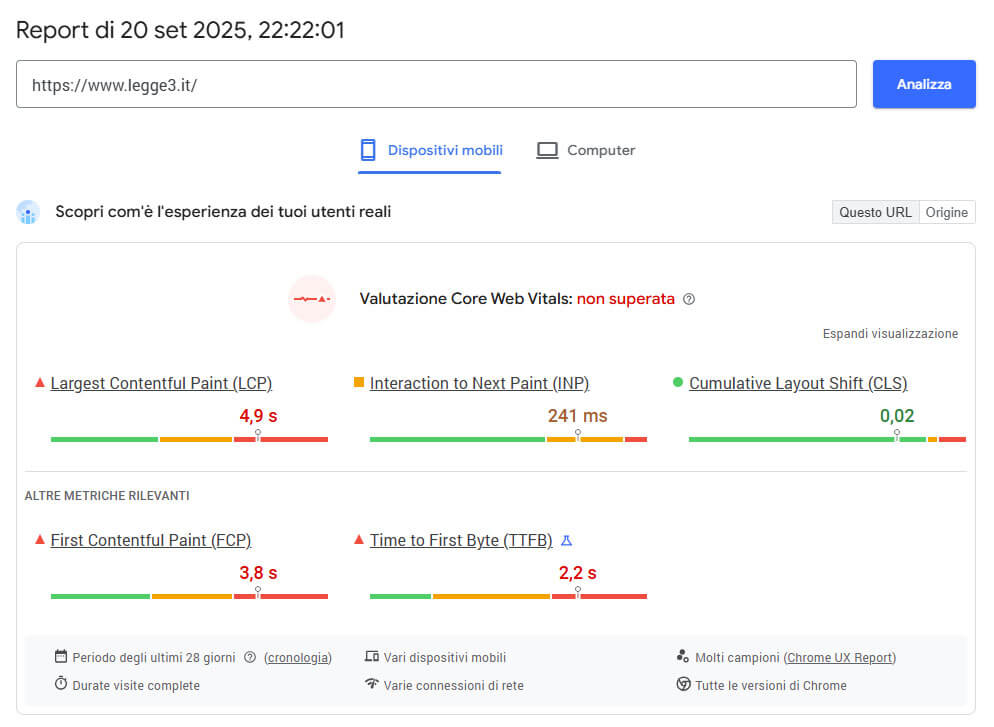
The overall rating is not passed for Core Web Vitals, mainly due to a too high LCP:
-
Largest Contentful Paint (LCP) : 4,9 s → well above the recommended threshold of 2,5 s.
-
Interaction to Next Paint (INP) : 241 ms → acceptable, below the 300 ms threshold.
-
Cumulative Layout Shift (CLS) : 0,02 → excellent, below the 0,1 threshold.
Other relevant metrics:
-
First Contentful Paint (FCP) : 3,8 s → slow, should stay under 2 s.
-
Actual TTFB : 2,2 s → a very high value, which confirms the critical issues that have already emerged.
3. General considerations
From an impartial point of view we can draw these conclusions:
-
The technological basis (WordPress on NGINX) is the same as already seen in other Stratego Swat projects, but not optimized on the server side.
-
Lack of compression and high TTFB are among the main bottlenecks.
-
Real-world usage data confirms that user experience is compromised: an LCP close to 5 seconds on mobile is unsatisfactory and causes a high abandonment rate.
-
A good INP and CLS score is not enough to compensate for excessively slow initial rendering and loading times.
4. Practical implications
A TTFB of more than 2 seconds and an LCP of almost 5 seconds have direct consequences:
-
SEO : Google considers these values insufficient and uses them as negative ranking signals.
-
Advertising : Campaign Quality Score can suffer, increasing costs per click and reducing profitability.
-
Conversions : The average mobile user doesn't wait five seconds to view the main content of the page. This translates into a high abandonment rate.
In contexts with suboptimal connections (rural areas, Sardinia, unstable 4G, radio links subject to weather), the critical issues become even more marked, amplifying the problem.
It's also important to note that TTFB is always a driving factor. A high TTFB will necessarily drive other parameters as well. TTFB (Time to First Byte) is the key parameter in web performance architecture, as it sets the starting point for all subsequent page loading and rendering processes. When TTFB is high, it inevitably creates a negative domino effect on all other Core Web Vitals: Largest Contentful Paint (LCP) can't begin until the browser receives the first byte of response from the server, First Input Delay (FID) is affected by the delay in executing JavaScript that must first be downloaded, and Cumulative Layout Shift (CLS) can worsen due to asynchronous and delayed resource loading. This happens because the browser follows a rigid sequential process: it must receive the initial HTML, parse it to identify critical resources (CSS, JavaScript, images), and only then can the visual rendering process begin. As a result, optimizing TTFB becomes the top priority in any web performance strategy , as even marginal improvements in this parameter amplify positively across the entire loading chain, making it possible to reach optimal thresholds for all Core Web Vitals.
Analysis of the third site: Sharknet (https://www.shark-net.com)
Analyses using Hosting Analyzer and Google PageSpeed Insights reveal a scenario with some positive aspects, but also significant critical issues from a performance standpoint.
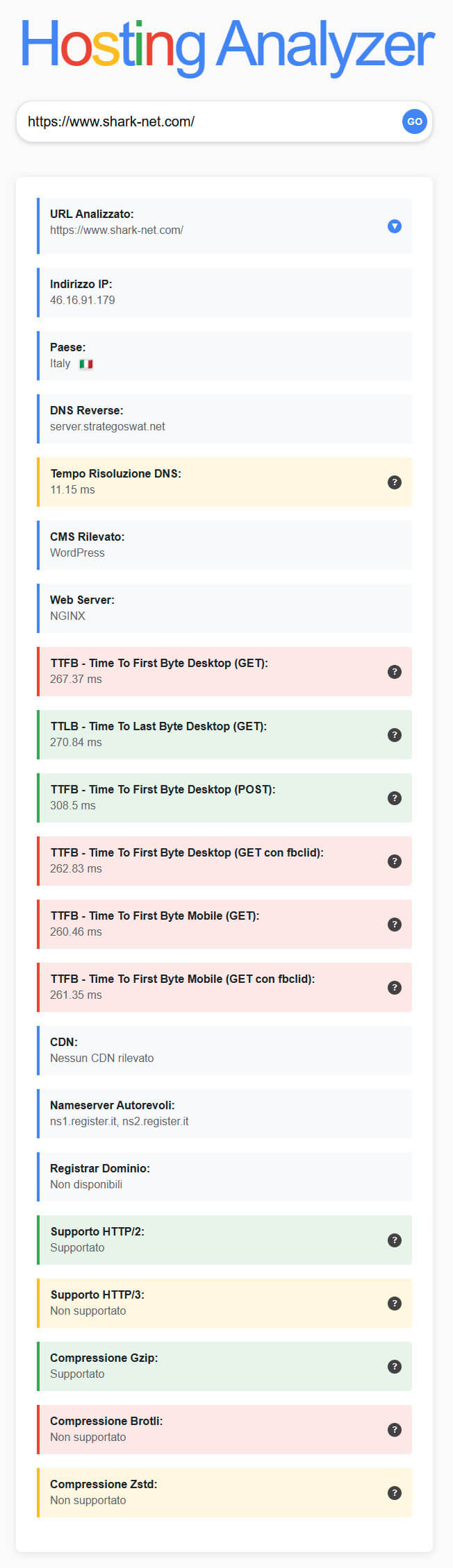
1. Hosting and server configuration
-
CMS detected : WordPress
-
Web server : NGINX
-
HTTP/2 support : active
-
HTTP/3 Support : Not Active
-
Compression : Enable Gzip only; Brotli and Zstd are not supported.
The Time To First Byte (TTFB) is higher than the threshold recommended by Google (200 ms):
-
Desktop: ~267 ms
-
Mobile: ~260 ms
These values are not as dramatic as those seen on legge3.it, but they remain above the recommended limit, negatively impacting the perceived speed and overall loading efficiency.
2. PageSpeed Insights and Core web Vitals
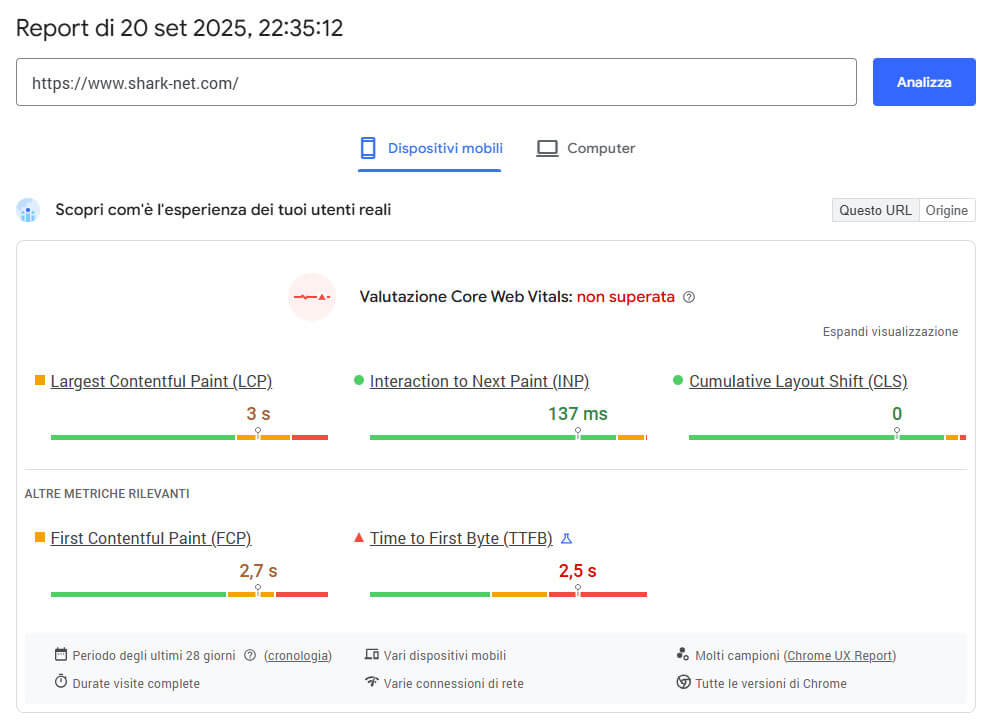
Real CrUX (Chrome User Experience Report) data is available for shark-net.com . The overall Core Web Vitals rating is not exceeded.
-
Largest Contentful Paint (LCP) : 3,0 s → above the 2,5 s limit.
-
Interaction to Next Paint (INP) : 137 ms → excellent, well below the 200–300 ms threshold.
-
Cumulative Layout Shift (CLS) : 0,0 → excellent, no visible shift.
Other metrics:
-
First Contentful Paint (FCP) : 2,7 s → borderline, but acceptable.
-
Actual TTFB : 2,5 s → very high, well above the recommended value of 0,2 s (200 ms).
3. General considerations
From a technical point of view:
-
The use of Gzip is a step up from other sites tested, but more modern compression options (Brotli, Zstd) are missing, which would have further improved performance.
-
LCPs above 3 seconds represent a real problem: the main part of the page takes too long to appear, risking user frustration.
-
CLS and INP, on the other hand, are excellent, which means that the page, once loaded, is stable and responsive.
4. Practical implications
An LCP over 3 seconds and a TTFB of 2,5 seconds make the site less competitive in terms of SEO and conversions. Specifically:
-
SEO : Google clearly flags non-compliance with Core Web Vitals. This can impact your rankings.
-
User experience : on slow networks (radio link, unstable 4G, rural areas) the problem becomes much more noticeable, leading to high abandonment rates.
-
Advertising campaigns : Slow loading reduces perceived quality and can reduce your ad's Quality Score, increasing costs.
Analysis of the fourth site: Alter Formazione (https://alterformazione.it)
The data collected through Hosting Analyzer and Google PageSpeed Insights show a rather critical situation in terms of performance, especially on the mobile side.
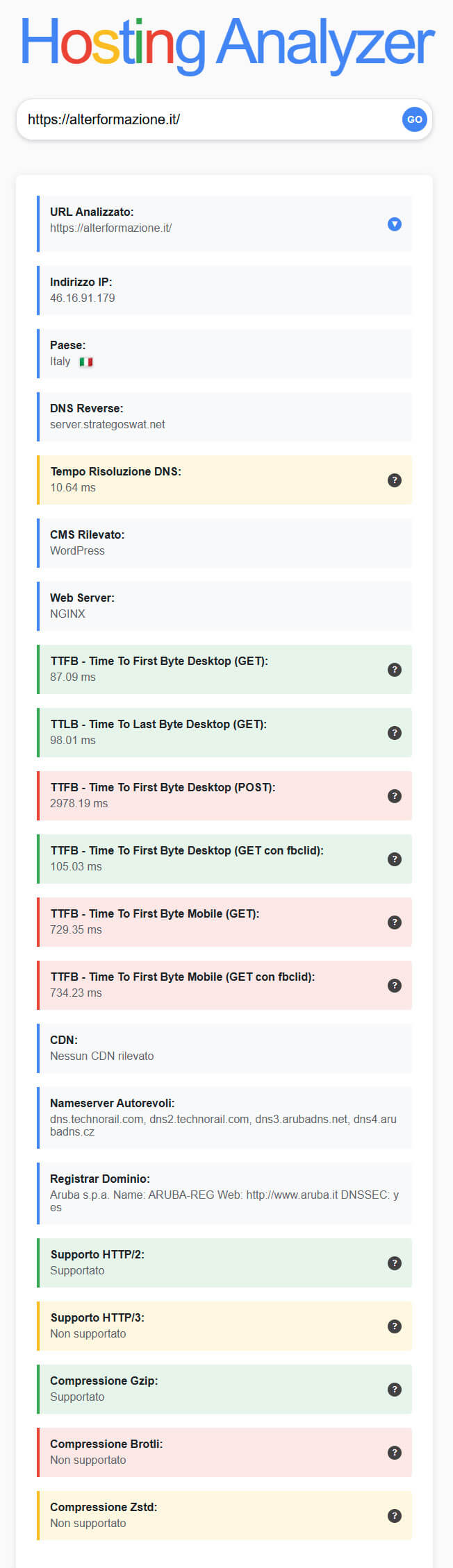
1. Hosting and server configuration
-
CMS detected : WordPress
-
Web server : NGINX
-
HTTP/2 support : active
-
HTTP/3 Support : Not Active
-
Compression : Gzip is enabled, while Brotli and Zstd are not supported.
The most interesting data is the Time To First Byte (TTFB) , which shows contrasting values:
-
Desktop : 87–105 ms (very good, below Google’s recommended threshold of 200 ms).
-
Mobile : 729–734 ms (well above the threshold, with unsatisfactory performance).
This discrepancy suggests that the server configuration is able to guarantee fast times in a desktop context, but not so much for mobile traffic, where factors such as resource weight, multiple requests or the lack of targeted optimizations likely come into play.
2. PageSpeed Insights
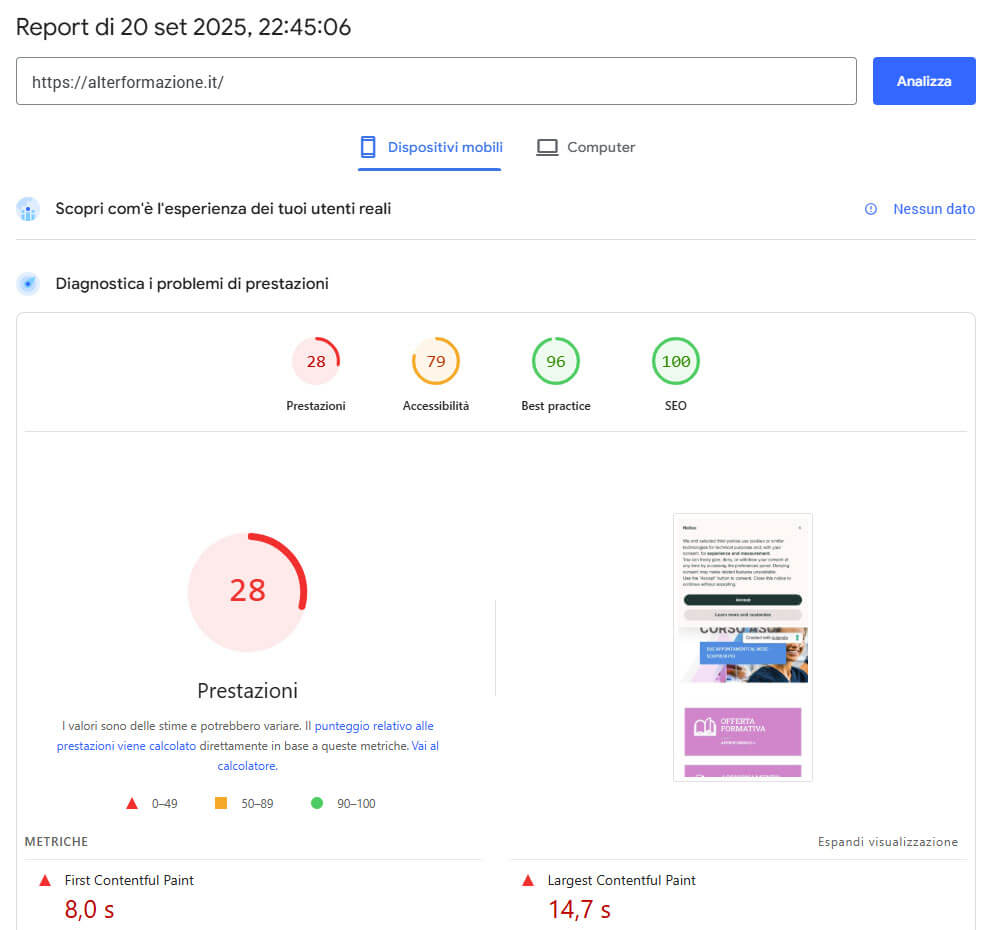
Google's mobile report paints a worrying picture:
-
Performance : 28/100 (red band, very low).
-
Accessibility : 79/100 (acceptable but room for improvement).
-
Best practices : 96/100 (very good).
-
SEO : 100/100 (excellent).
Rendering metrics are extremely bad:
-
First Contentful Paint (FCP) : 8,0 s → well above the recommended threshold (<2 s).
-
Largest Contentful Paint (LCP) : 14,7 s → critical value, the main content becomes visible too late.
3. General considerations
From a technical point of view, strong imbalances can be noted:
-
From the SEO and implementation best practices perspective , the site performs well.
-
From a real-world user performance perspective , the situation is very problematic. An LCP of nearly 15 seconds makes the site practically unusable on mobile devices under average or poor network conditions.
-
The very good desktop TTFB does not translate into real fluidity: the main problem is related to the excessive weight of the page and the lack of resource loading optimizations.
4. Practical implications
A site with these characteristics presents concrete risks:
-
Bad user experience : such long times make people abandon browsing before even viewing the content.
-
SEO penalized : despite the technical score of “100” on the SEO side, the Core Web Vitals values are so poor that they negatively impact the ranking.
-
Paid campaigns : Any advertising investment risks being jeopardized by extremely slow mobile loading, resulting in higher CPCs and lower conversion rates.
In poor connectivity scenarios (unstable 4G, radio connections in rural areas, adverse weather conditions), a 14-second LCP becomes a real exclusion factor: the user does not stay online and wait.
Analysis of the fifth and final site: Oro Etic (https://www.oroetic.it)
The site shows a significantly better situation than other projects analyzed, but with significant room for improvement, especially on the server side.
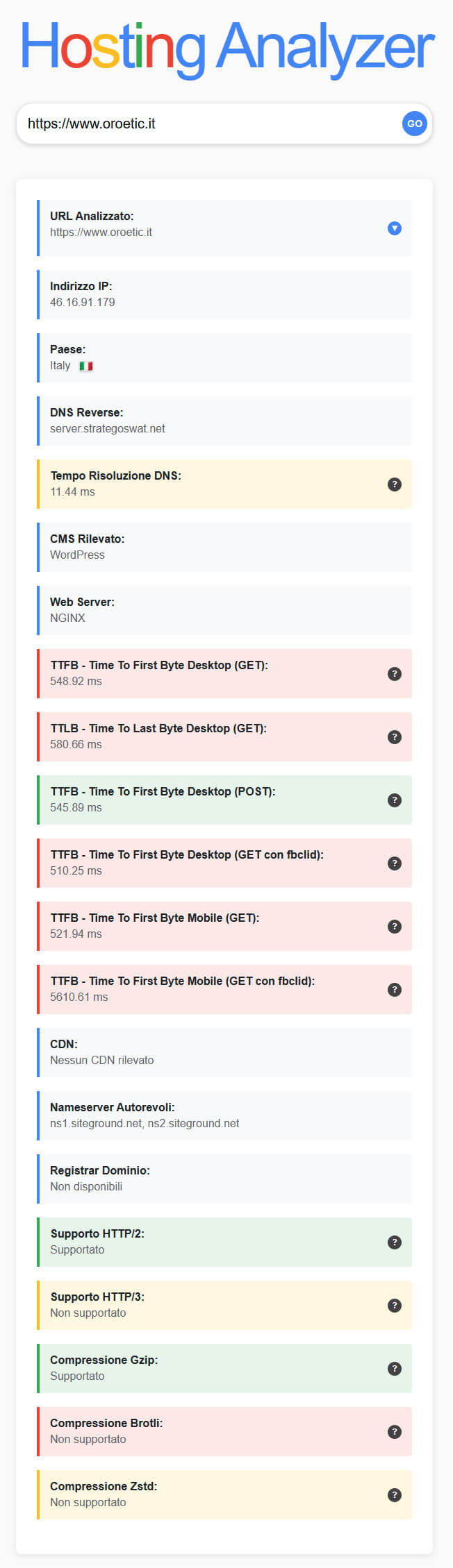
1. Hosting and server configuration
-
CMS detected : WordPress
-
Web server : NGINX
-
HTTP/2 support : active
-
HTTP/3 Support : Not Active
-
Compression : Enable Gzip only; Brotli and Zstd are not supported.
Time To First Byte (TTFB) remains critical:
-
Desktop: ~549 ms
-
Mobile: ~520–560 ms
These values are significantly above Google's recommended threshold of 200 ms . While not as limiting as other sites in the group, they represent a bottleneck that slows down the initial delivery of the page.
2. PageSpeed Insights and Core web Vitals
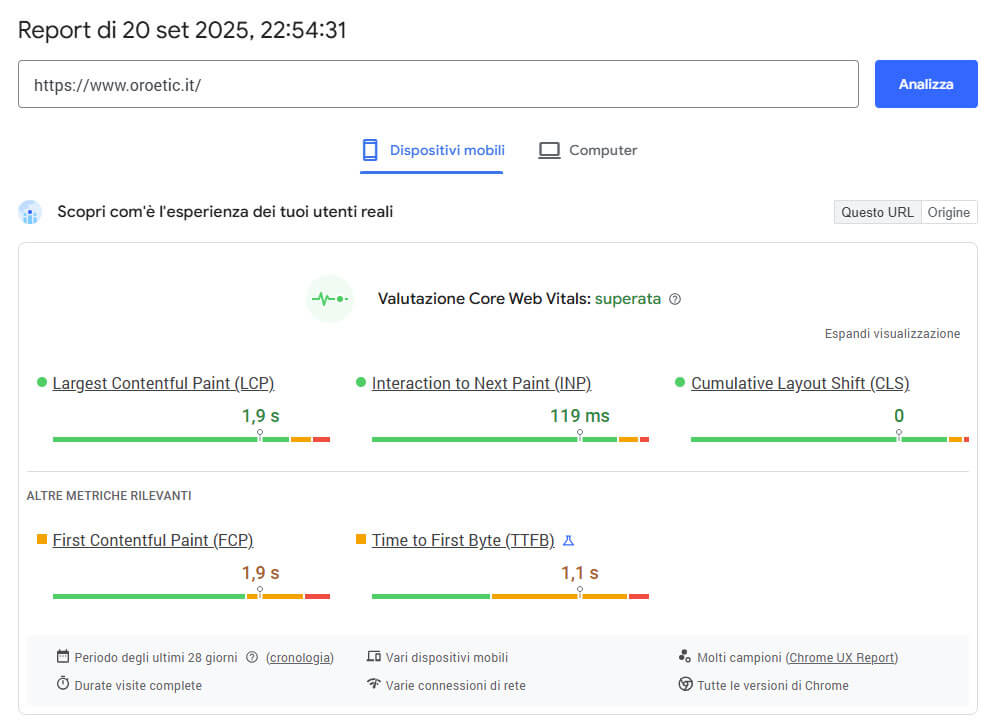
Here the strengths emerge:
-
Core web Vitals rating : passed.
-
Largest Contentful Paint (LCP) : 1,9 s → excellent, below the critical threshold of 2,5 s.
-
Interaction to Next Paint (INP) : 119 ms → excellent, well below 200–300 ms.
-
Cumulative Layout Shift (CLS) : 0,0 → perfect, no visible shift.
Other metrics:
-
First Contentful Paint (FCP) : 1,9 s → in line with best practices.
-
Actual TTFB : 1,1 s → confirms the delay already detected by Hosting Analyzer.
3. General considerations
From a technical standpoint, oroetic.it stands out for the overall quality of its user experience : the main contents become visible quickly and the interaction is fluid.
However, TTFB still represents a weak point. While it doesn't prevent the Core Web Vitals from being exceeded, it remains well above the recommended target of 200 ms. This means that, with a more efficient hosting infrastructure , overall loading times could be further reduced, with tangible benefits for:
-
SEO : Google rewards not only exceeding the Core Web Vitals, but also fast server response times.
-
User experience in challenging scenarios : Unstable 4G networks, radio connections or rural areas would make the delay of more than half a second in the initial response more noticeable.
-
Advertising Campaign ROI : Even small optimizations in loading times can significantly increase conversion rates.
4. Practical implications
In short, oroetic.it represents a case where the usability and rendering metrics are excellent , but the infrastructure (TTFB) continues to be the limiting factor. Investing in performance-optimized hosting would allow an already competitive site to be consolidated, eliminating the last technical bottleneck.
A general evaluation and consideration of the tested sites
From the analysis conducted on various sites bearing the Stratego Swat signature, a rather clear picture emerges: in almost all cases, Google's Core Web Vitals are not exceeded . This data, in itself, is indicative of an approach in which the technical aspects of hosting and performance optimization do not receive the same attention as graphics or communication strategies.
Another recurring issue is the lack of modern compression protocols. In some cases, the use of Gzip is observed , now considered outdated and less efficient than the more modern Brotli (the de facto international standard) and especially compared to Zstandard (ZSTD) , an emerging technology that we at Managed Server SRL are the first and only ones in Italy to provide natively in our server stack , without relying on third-party solutions like Cloudflare.
Another commonality is the lack of HTTP/3 (QUIC) , which none of the analyzed sites adopt. This protocol, a natural evolution of HTTP/2, guarantees lower latencies and greater stability on unstable mobile connections, but it appears not to be implemented. Support for more efficient image formats, such as WebP , also appears limited: only one of the tested sites uses it, and it is the same one that manages to exceed the Core Web Vitals, a clear sign of a direct link between technological choices and concrete results.
Furthermore, analyzing the HTTP headers and TTFB values reveals no server-side caching configurations. Technologies such as NGINX 's native caching or, even better, the use of Varnish Cache would have significantly reduced response times. The high TTFBs (often over 500 ms and in some cases over 2 seconds) could have been reduced to values well below 50 ms with adequate and optimized infrastructure.
Finally, a significant technical detail: all the sites analyzed are hosted on the same server , with the same IP address ( 46.16.91.179 ) which refers to ServerPlan, and are managed via the Plesk control panel . Plesk is certainly one of the most well-known and widespread solutions, superior to alternatives like cPanel, DirectAdmin or open source solutions like Webmin, but it still has structural limitations in the implementation of advanced configurations for web performance . In other words, while guaranteeing ease of use and stability, it does not allow you to reach the levels of optimization required today to compete on performance, SEO and conversions.
What should a technologically appropriate landing page look like?
When it comes to landing pages, most agencies tend to focus on graphics, copywriting, and persuasion . These are key aspects, of course, but they're not enough. A truly effective landing page is one that can convert campaign traffic into leads and sales, without losing value along the way. And to achieve this, the underlying technology is just as important as the visual and textual content.
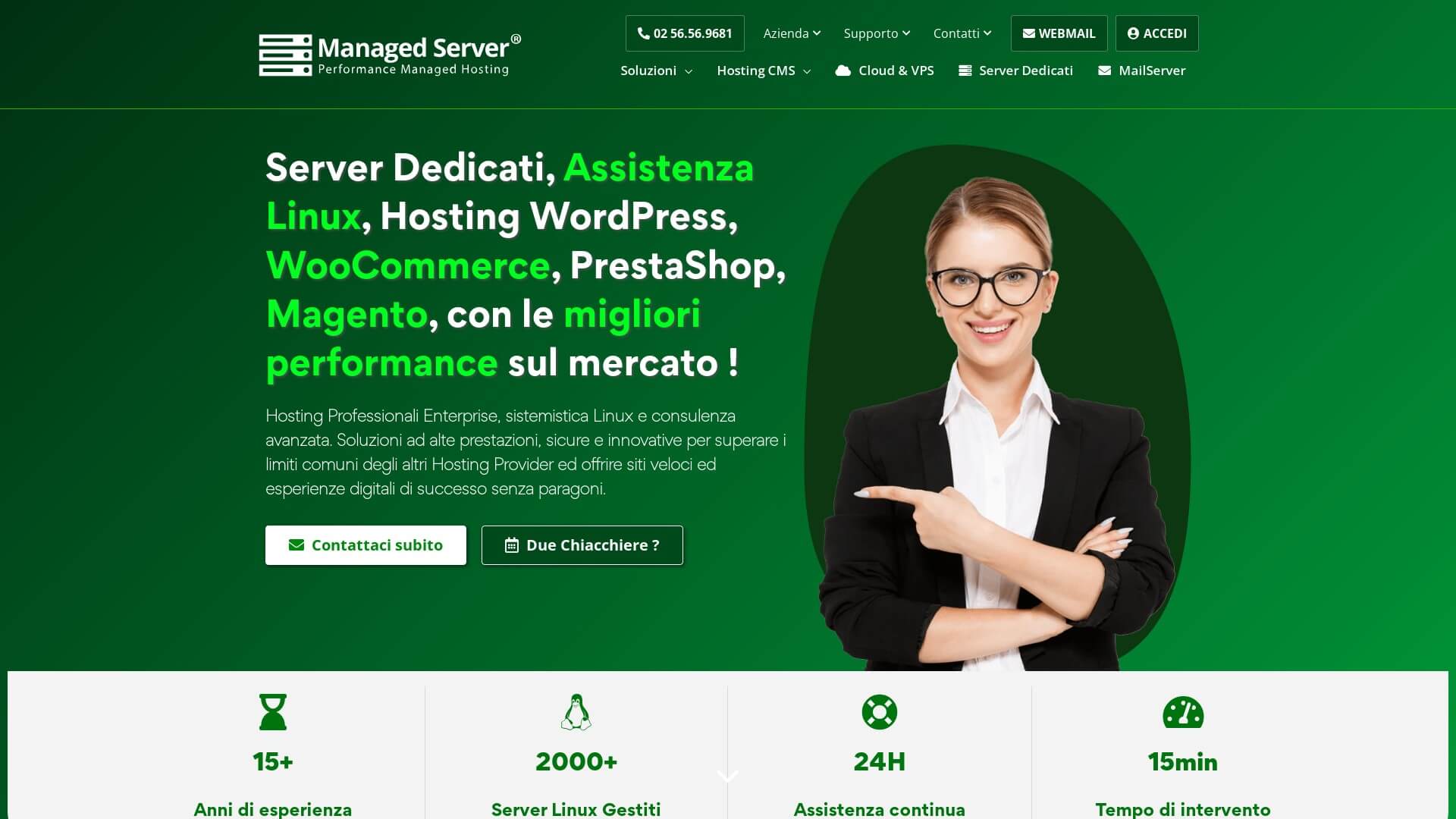
Let's take the landing page for our website managedserver.it as an example . The technical analysis clearly shows what it means to build a project optimized for performance and designed with Google's Core Web Vitals in mind.
Real-world performance and response times
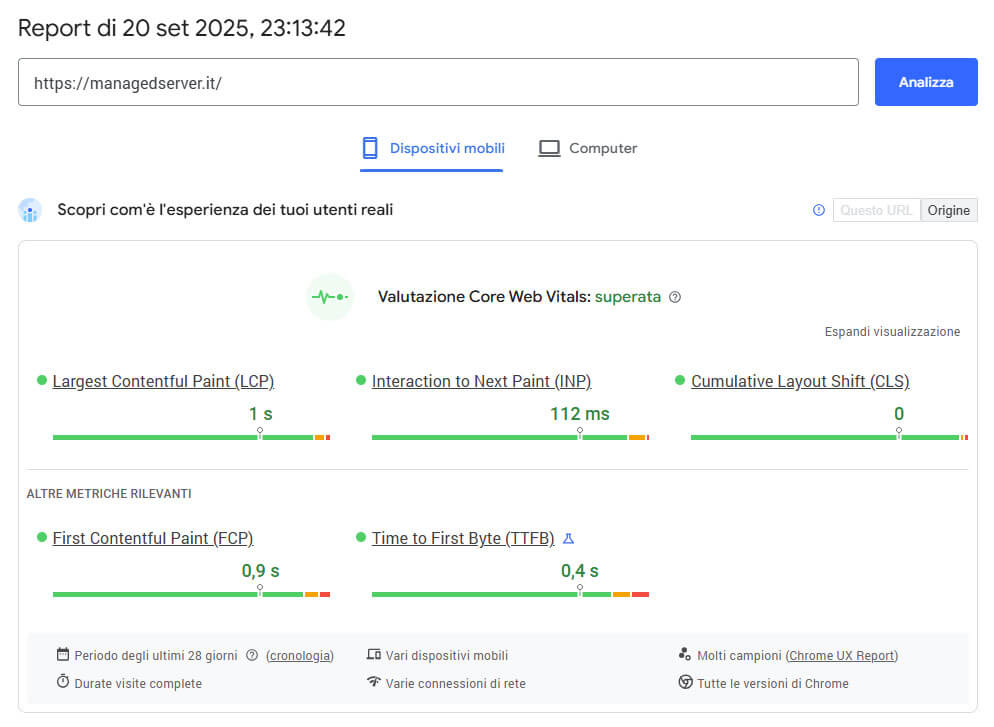
-
TTFB (Time To First Byte) in the range of 30–40 ms , well below the 200 ms threshold recommended by Google. This means the server responds immediately, without making the user wait.
-
FCP (First Contentful Paint) under 1 second: Content starts appearing almost immediately, improving the perception of speed.
-
LCP (Largest Contentful Paint) of approximately 1 second: the main content is visible in optimal times, with a perceived extremely smooth experience.
-
CLS (Cumulative Layout Shift) equal to 0: the page is stable, no content “jumps” during loading.
-
INP (Interaction to Next Paint) just above 100 ms: interactions are immediate, with no perceptible delays.
These values are not random, but the result of precise choices: an optimized hosting infrastructure, an advanced caching layer and modern protocols such as HTTP/2, HTTP/3 (QUIC) , multiple active compressions ( Gzip, Brotli, ZSTD ) and a server-side implementation that minimizes latency.
Resource optimization
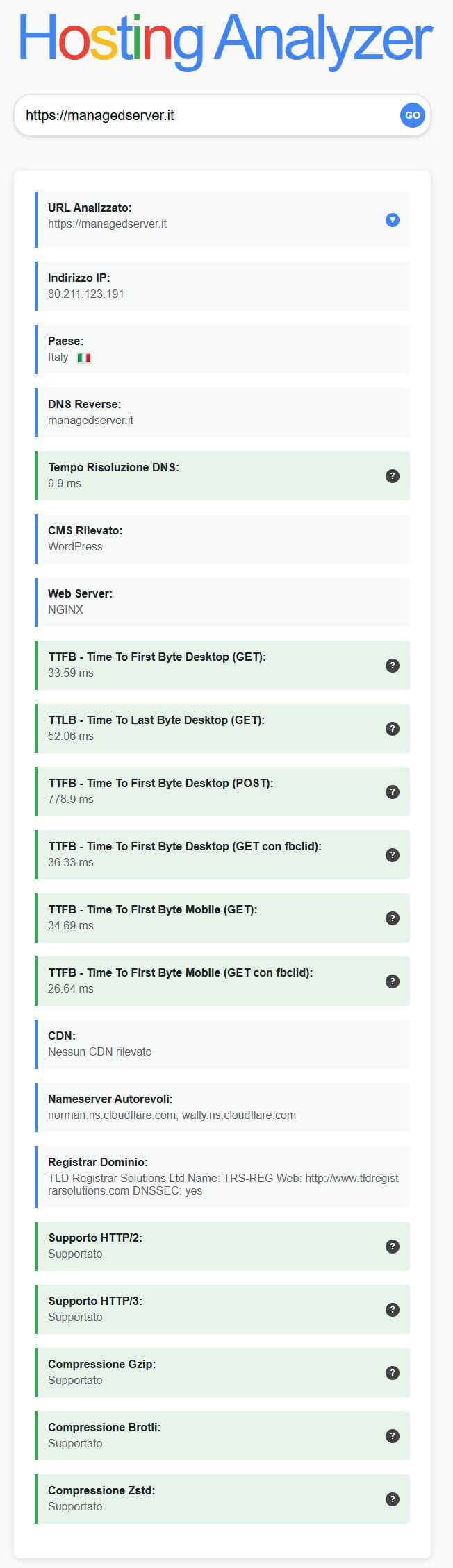
Another key element is the management of static resources (images, CSS, JavaScript). On managedserver.it we use:
-
Modern formats like WebP for images, which dramatically reduce weight without compromising quality.
-
Minification and concatenation of CSS and JS files, to reduce the number of requests and speed up loading.
-
Server-side caching (NGINX + Varnish) to instantly serve content to users, reducing wait times.
Marketing and query strings
An often overlooked aspect is the management of marketing query string (As fbclid of Facebook or gclid (of Google Ads). These parameters, if not treated correctly, generate Unique URLs for each visit, invalidating caching and forcing the server to regenerate the same page for each user.
At managedserver.it, we've implemented intelligent query string stripping : parameters are recorded for tracking purposes but don't impact site performance. This way, even traffic from Facebook or Google campaigns is served with the same speed and stability as direct visits, without penalties.
The overall experience
A technologically adequate landing page must be conceived as a coherent system, where every element—from the server to compression, from caching to query string management—works to reduce loading times and improve the user experience . It's not just a matter of "pleasing Google":
-
a faster page reduces the bounce rate ,
-
improve the Quality Score of advertising campaigns,
-
increases the conversion rate , because the user stays longer and performs the desired action.
The example of managedserver.it demonstrates how technology can be a powerful tool for efficiency. Creating a visually appealing page isn't enough: it needs to be built on an optimized infrastructure that can guarantee consistent and predictable performance , even in challenging network conditions (unstable 4G, rural areas, poor wireless connections).
That's why, when it comes to landing pages and lead generation, hosting and performance aren't technical details , but real business factors.

Conclusions
Hosting is often considered a secondary technical aspect, almost invisible to the end customer. As long as the bottom line looks positive—more leads coming in than campaign spending—it might seem like there's no reason to worry. But this is a reductive view, overlooking the true potential of a well-structured digital strategy.
Returning to the principles of operations research means looking beyond the short term: maximizing revenue and minimizing costs isn't just a matter of campaign optimization, but also involves the technical infrastructure. Fast, high-performance hosting isn't an additional cost, but a tool for reducing the real costs of lead generation, making every ad click more effective, reducing abandonment and increasing conversions.
Furthermore, a technically optimized website opens the door to an additional benefit: natural organic positioning . A website that meets the Core Web Vitals, with fast loading times and stable performance, not only supports paid campaigns but can also achieve and maintain better positions on Google over the long term. This means receiving additional leads continuously and free of charge , without relying solely on your advertising budget.
In this scenario, agencies should adopt a collaborative approach: learning to "pass the ball" and focus on the areas where they truly excel—creativity, communications, strategy—relying on specialists for the more delicate technical aspects, such as hosting and web performance . This way, each party works to the fullest extent of their expertise, and the result is a winning team effort for the end client , who obtains not only an immediate return on campaigns but also a lasting competitive advantage thanks to organic growth over time.

