











Support
MongoDB®
- Intervention byurgency on accidents and malfunctions.
- Contracts of assistance e maintenance with ALS.
- Design, tuning e optimization.
- Integration with platforms, e-commerce and custom applications.
- Hardening, of your digital ecosystem. e high reliability.
On premise
and in the cloud:
Need MongoDB® support?
A single technical partner for the entire MongoDB lifecycle
Why choose MongoDB®
Flexible data, horizontal scalability, faster development
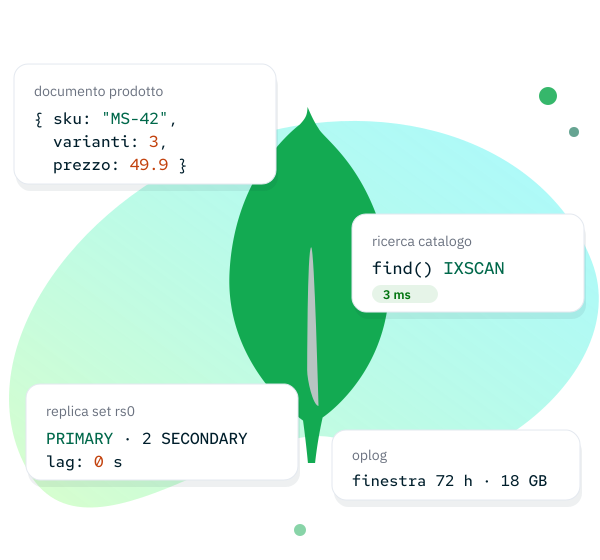
MongoDB stores data as documents that mirror application objects: a product with its variants, an order with its rows, a user with their preferences are all contained in a single document, read and written to in a single operation. The model can evolve without blocking schema migrations.
Secondary indexes, aggregation pipelines , geospatial search, time series, and ACID transactions across multiple documents allow it to be used as the primary database for even complex applications, not just as a backup archive.
To help you grow, MongoDB offers set replication with automatic failover and sharding to distribute data and load across multiple servers. For companies, this means reduced development time , high availability , and an infrastructure that scales with your business.
Our job is to transform this potential into measurable results, with an architecture designed around your load and continuous monitoring over time.
Implementation on web platforms and services
MongoDB for headless e-commerce, catalogs, content, and analytics
MongoDB is often the database for headless architectures and services that run alongside the CMS: product catalogs with different attributes for each category, content and translations, shopping carts and customer profiles, logs, events, and analytics data collected in real time.
We design documents based on how the application reads and writes them, we choose when to embed data and when to use references, and we define the indexes that are really needed, because each additional index slows down writes and takes up memory.
The result is a platform that can handle high volumes of reads and writes, with stable response times even during peak periods like sales and Black Friday.
MongoDB implementation on custom applications
Integration with enterprise application frameworks and stacks
We integrate MongoDB into applications developed with Node.js and Express or NestJS, Python and Django or FastAPI, Java and Spring Data , Go , .NET , Ruby on Rails and PHP with Laravel and Symfony, using official drivers.
We work with your team on document schema , indexes, transactions , change streams to react to changes in real time, and schema validation, so that the flexibility of the model doesn't become clutter.
We also check the client side: connection pool , timeout, write concern and read preference , primary election management, because an application that doesn't know how to react to a failover undermines any high-availability architecture.
Advanced configuration and custom tuning
Advanced configuration, monitoring and customization
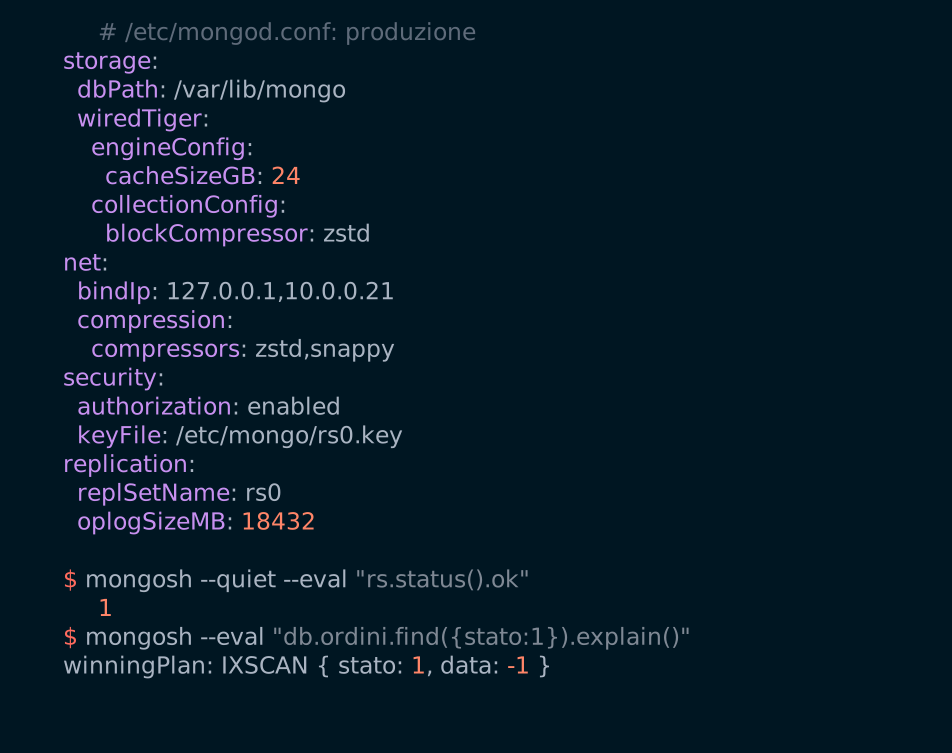
We design the MongoDB configuration starting from the data: collection and index size, read-to-write ratio, most frequent and slowest queries. Based on this, we size the WiredTiger cache , which by default occupies about half the RAM, and select data and index compression .
We define the oplog size to accommodate maintenance windows and node downtime, the appropriate write concern and read concern levels for each operation, and the system parameters that MongoDB requires, such as an XFS filesystem, properly handled transparent huge pages, and appropriate open file limits.
Each installation is supported by continuous monitoring : replication delay, oplog window, cache usage, connections, slow operations, disk space, and backup status. Anomalies are identified before they become a problem for users.
The result is a predictable, documented MongoDB that integrates into your application ecosystem.
Diagnosis and troubleshooting
Quickly address slow queries, replication, and anomalous behavior
Queries that go from milliseconds to seconds, CPUs maxing out, disks filling up, secondaries falling behind until they exit the oplog, constant primary elections, or exhausted connections: these are problems that directly impact revenue and reputation, and they need to be resolved quickly.
Our method is structured: analyzing logs, profilers, and execution plans ; identifying complete collection scans , missing or unused indexes, oversized files, and locks; identifying the cause and implementing a permanent fix . When necessary, we immediately apply a temporary solution to restore service and complete the resolution at a later time.
Critical incidents are handled with priority and within the timeframes set by the SLA , by systems engineers who know MongoDB inside out.
Safety and Incident Management
Structured procedures and transparent communication
Thousands of MongoDB databases exposed to the Internet without authentication have been emptied and held hostage in recent years. That's why we're implementing configuration hardening : mandatory authentication , roles with only the necessary permissions, listening only on private interfaces, TLS between the application and nodes, and firewalls that limit access to port 27017.
We monitor the project's security bulletins and activate our incident management procedures when vulnerabilities are identified . This happened with MongoBleed (CVE-2025-14847) , a flaw in zlib compression that allowed server memory to be read without authentication. This flaw was actively exploited and fixed in versions 8.2.3, 8.0.17, 7.0.28, 6.0.27, 5.0.32, and 4.4.30. Where the update wasn't immediate, the mitigation was to disable zlib and use zstd or snappy.
We assess the impact on your installation, apply mitigations, and provide clear and timely information on the nature of the problem, risks, and status of the intervention.
Updates and life cycle
Complete update management, without production risks
We keep MongoDB up to date with security patches , fixes, and new releases. With a replica set, the update happens one node at a time , starting with the secondaries, without stopping the application.
Major version updates must be done sequentially, one version at a time, checking the feature compatibility version , drivers, and deprecated features. We prepare a rollback plan and manage the entire process, even from very old versions.
We keep an eye on the lifecycle: MongoDB 6.0 is out of support as of July 31, 2025 , and 7.0 will be out of support as of August 31, 2027. We also help you with licensing choices between Community Edition (SSPL) and Enterprise , and with evaluating managed services like MongoDB Atlas versus your own installation.
Your team is free to focus on your business, knowing that MongoDB is always up to date, secure, and supported.
Consulting and training
Transferring skills to your team
MongoDB is easy to get started with, but not easy to scale: document modeling, index selection, and sharding key are difficult decisions to change later. We answer your team's questions about data modeling, architecture, and best practices , providing clear and verified answers, within the timeframes set by the SLA.
Upon request, we organize training sessions for developers and system administrators and provide documentation of the configuration created, so that the know-how remains within the company.
Operational on premise and on major cloud providers.
Your infrastructure, wherever it is
We run MongoDB on physical servers in your data center, on private infrastructure, in containers, and on major public clouds. We operate daily on AWS, Microsoft Azure, Google Cloud, Alibaba Cloud, IBM Cloud, Hetzner, OVHcloud, Linode, and DigitalOcean , and we also support MongoDB Atlas users.
Whether you're considering a migration to the cloud , between providers, or from Atlas to your own installation and vice versa, we design the architecture and move your data with replication or official migration tools to maintain performance and service continuity throughout the journey.
You can open a ticket at any time: our team of Linux system administrators intervene remotely, wherever your infrastructure is located.
GDPR compliant
Data processed in the European Union, in compliance with Regulation (EU) 2016/679
We are an Italian company and operate in full compliance with the GDPR . Your infrastructure information, tickets, and support communications are treated with strict security and confidentiality criteria.
Data is stored exclusively within the European Union and deleted within 30 days of completion of the activity . Our procedures follow industry best practices regarding data protection and retention, to offer you full regulatory compliance.
FAQ
MongoDB is a document-oriented NoSQL database. Instead of rows and tables, it stores documents in BSON format, similar to JSON, grouped into collections: each document can have a different structure and contain nested data and lists.
It offers secondary indexes, rich queries, aggregations, ACID transactions across multiple documents, replication with automatic failover, and sharding to distribute data across multiple servers. It is used for catalogs, content, user profiles, IoT, logs, and real-time analytics.
MongoDB makes development faster and infrastructure growth easier. This means:
Faster development, because the data has the same shape as the application objects.
Flexible scheme, which evolves without blocking migrations.
High availability, with replica sets electing a new primary within seconds.
Horizontal scalability, with sharding when a single server is no longer enough.
We cover the entire lifecycle: architecture analysis and design, document modeling, installation and configuration, set replication and sharding, indexes and query optimization, backup and recovery, migration from other databases, from legacy versions, or to and from MongoDB Atlas.
In production, we offer continuous monitoring, performance analysis, updates, security audits, SLA-compliant troubleshooting, and internal staff training. Services are available as both a one-time intervention and an ongoing support agreement.
MongoDB starts simple and becomes complex as your data grows. Specialist support is particularly useful if:
Queries slow down as the collections grow.
CPU, memory or disk I'm constantly on the edge.
You have only one knot and no failover in case of failure.
You are not sure about backups or you have never tried them in a recovery.
Use an out-of-support version or you don't know if the instance is exposed.
An initial analysis allows us to estimate the margin for improvement before any investment.
It depends on the data and how it's used. MongoDB is ideal when the structure varies from one element to another, such as in catalogs with different attributes, when data is almost always read together, and when horizontal scaling is needed. A relational database is often the best choice for highly connected data and for reporting with complex joins.
Many modern architectures use both. We'll help you decide based on your specific case and, if necessary, migrate in one direction or the other.
Yes. MongoDB has official drivers for all popular languages and mature libraries for major frameworks, such as Mongoose for Node.js and Spring Data for Java.
We work with your team to define the document schema, indexes, transaction usage, and client-side error handling, including connection pools, timeouts, and failover response. This ensures MongoDB stays fast even as your data grows and your application evolves.
After going into production, we continue to monitor and optimize the configuration as the load changes.
MongoDB runs on Linux, Windows, and macOS; for production, we recommend Linux on physical servers, virtual machines, or cloud instances with fast disks. Resources should be sized so that frequently used indexes and data fit in memory, in the WiredTiger cache.
For high availability, you need at least three members in the replica set, even on different servers or zones. You also need an XFS file system, adequate system limits, and a private network between the application and the database. If these skills aren't available in-house, we can handle the entire project, from sizing to day-to-day management.
MongoDB Community Edition is free, distributed since 2018 under the SSPL license, and covers the vast majority of projects. Enterprise adds features such as LDAP and Kerberos authentication, auditing, and integrated data-at-rest encryption, with official paid support. Atlas is MongoDB's managed service on major clouds.
The choice depends on your security and compliance requirements, costs, and the control you want to maintain over your infrastructure. We'll help you evaluate it and, if necessary, migrate from one solution to another.
Yes. Managed Server is an Italian company and provides its services in compliance with the General Data Protection Regulation (EU Regulation 2016/679). Data relating to your infrastructure and support requests are processed within the European Union and deleted within 30 days of completion of the services.
It depends on the size of the data and the required restore point. For small databases, mongodump and mongorestore are sufficient; for large ones, we use filesystem-consistent snapshots, taken from a secondary node to avoid overloading the primary, and possibly continuously saving the oplog to return to a specific point in time.
On sharded installations, backups must be consistent across all shards. In any case, backups are stored separately from the database, and restores are attempted periodically, not just scheduled.
Disclaimer and Legal Notices: MongoDB® and Linux® are registered trademarks. In particular, MongoDB® is a registered trademark of MongoDB, Inc. Linux® is a registered trademark of Linus Torvalds in the United States and other countries. MANAGED SERVER SRL is not affiliated with, sponsored by, or otherwise associated with MongoDB, Inc., or Linus Torvalds, and does not represent any of these entities in any way. All rights to the brands and product names mentioned are the property of their respective copyright holders.
DDOS protection and mitigation with Arbor Networks & CloudFlare ®
- DDOS protection and mitigation included in every Hosting plan
- Intelligent detection of Layer 3 and 7 volumetric attacks
- Automatic DDOS Layer 3 Mitigation via Arbor Networks
- Manual DDOS Layer 7 Mitigation with CloudFlare WAF