
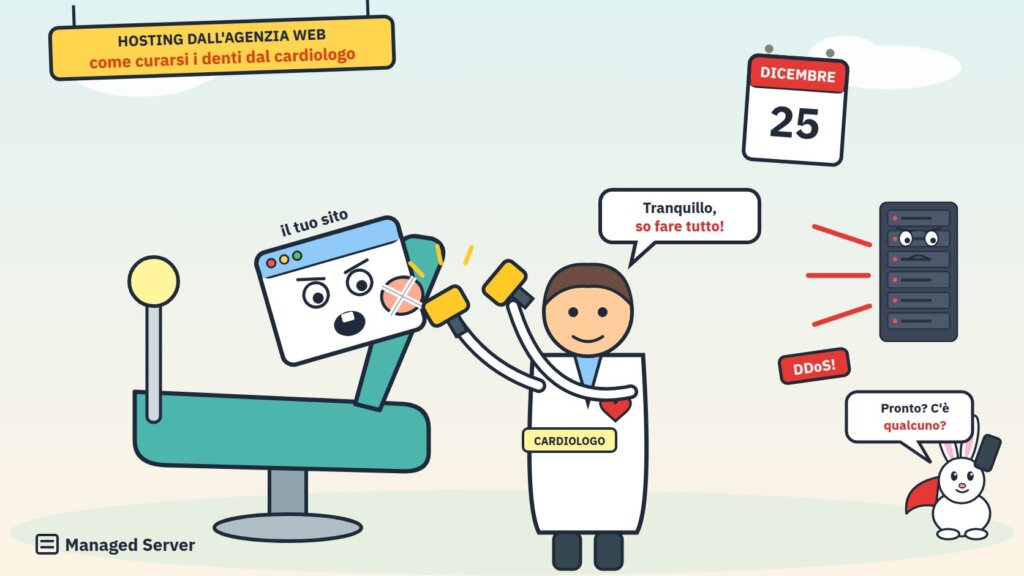
Table of contents of the article:
It happens every day. A company commissions a new website from a trusted web agency or webmaster. The design goes well, the graphics are liked, the site is delivered. And finally, almost like a detail, the proposal arrives: "We'll put the site on our servers, so we can take care of everything."
It seems convenient, it seems logical, it even seems like a guarantee: whoever built the website knows it better than anyone else. In reality, it's one of the worst decisions you can make. Not because the agencies are dishonest or incompetent, but because building websites and managing infrastructure are two different professions, with skills, tools, costs, and responsibilities that have almost nothing in common.
In this article, we explain why, by describing what we see when these sites, sooner or later, reach us.
Two different professions, two different languages
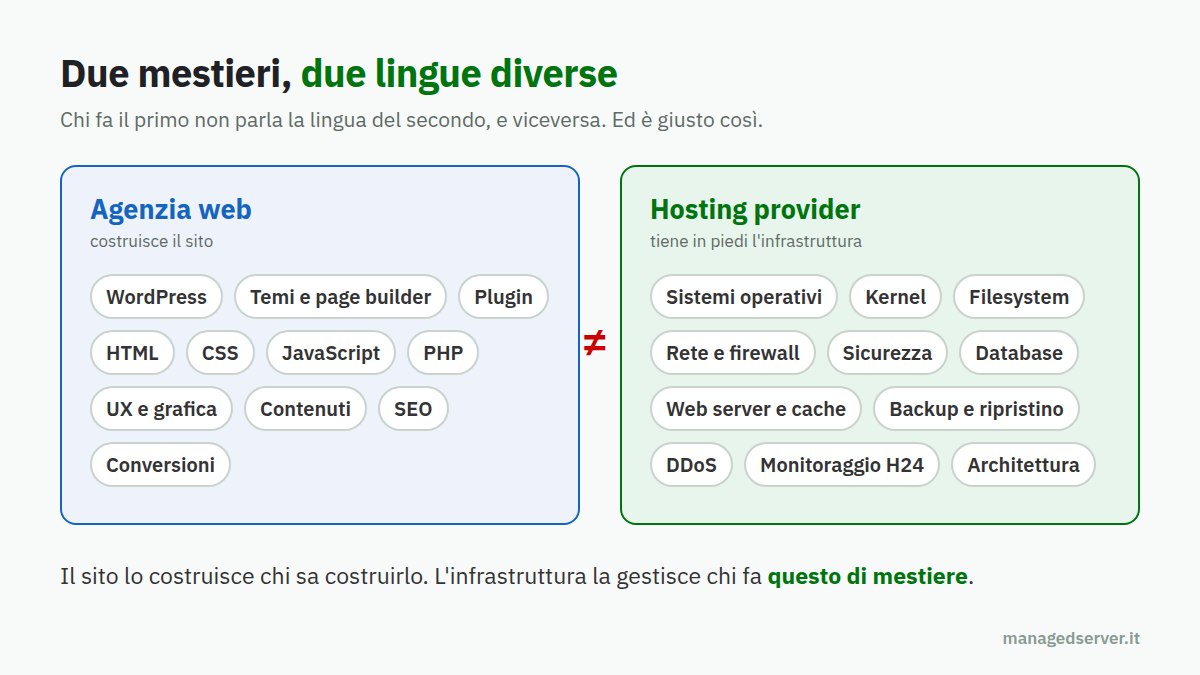
Website designers work with WordPress, themes, page builders, plugins, HTML, CSS, JavaScript, and PHP. They think about user experience, graphics, content, conversions, and SEO. It's a difficult, creative, and technical job, and those who do it well deserve all the respect in the world.
Hosting managers work on a different level: operating systems, kernels, filesystems, permissions, networks, firewalls, security, databases, web servers, caches, backups, data replication, monitoring, capacity, and architecture. They deal with latencies, queues, processes, attacks, failures, and recoveries.
The point is that those who do the first job don't speak the language of the second, and vice versa. An excellent WordPress developer doesn't necessarily know how to size MariaDB, read the output of a vmstat, understand why the kernel is killing processes due to lack of memory, or recognize an application attack from NGINX logs. Likewise, a great system administrator isn't the right person to design your website or choose a theme.
There's nothing wrong with that: it's the normal specialization of professions. The problem arises when one of the two pretends to do the other.
The cardiologist and the toothache
Imagine having a toothache and going to the best cardiologist in Europe. He studied medicine, is an excellent surgeon, and has an exceptional hand. But his skills and instruments are designed to do other things well, and certainly not to fix a tooth.
No one would do it, yet it happens all the time on the web. Someone who does one thing well doesn't necessarily have to be good at something else just because they "work on the internet." The web isn't a single profession: it's a collection of different professions that work on the same thing, just like medicine.
Even when the skills are there, economies of scale are lacking.
There are, it's true, agencies that employ a person with operating systems expertise, the so-called DevOps. These are rare cases, but they do exist. And even then, the problem isn't solved, because professional infrastructure management isn't just a matter of skills. It's a matter of scale.
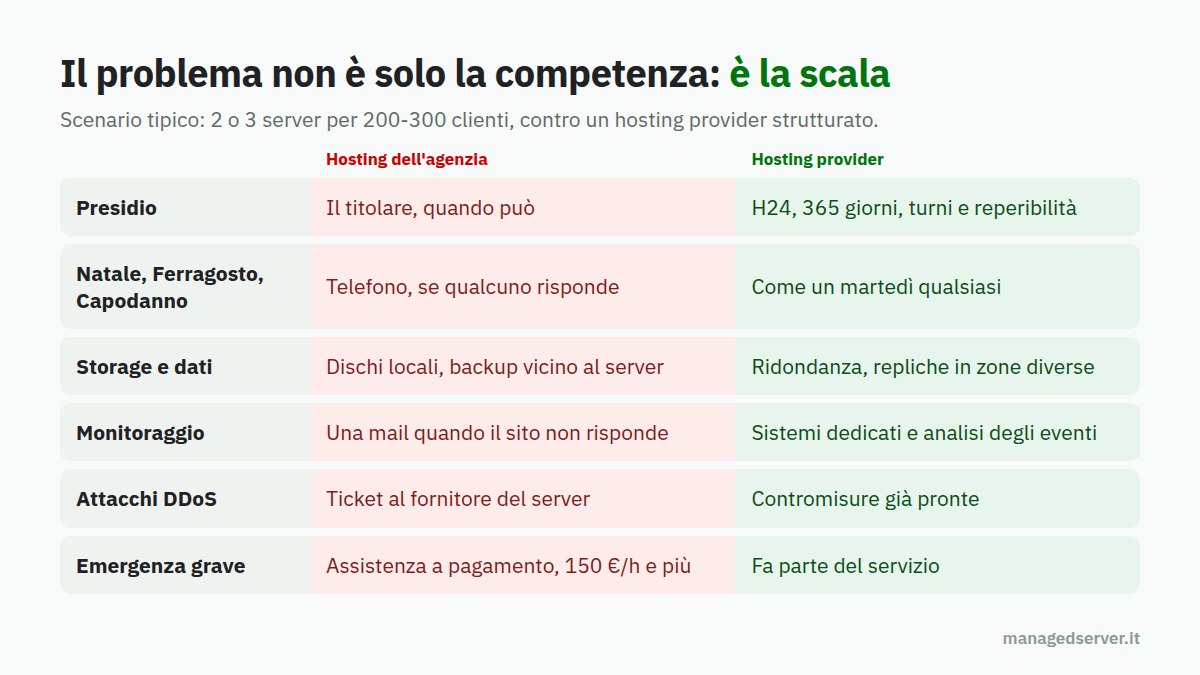
You can't expect to have two or three servers running two or three hundred clients and, simply because you have them, manage them professionally. Professional hosting comes with a very high fixed cost, which only makes sense when distributed across a very large number of clients.
The 24/7 garrison, 365 days a year
A server doesn't fail during office hours. Attacks don't follow a schedule. A serious hosting service requires staff who can guarantee 24-hour supervision and protection, 365 days a year, including nights and holidays: during Christmas lunch, on August 15th, and on New Year's Eve.
To have someone truly available and clear-headed at any time, just one person with a phone turned on isn't enough. You need shifts, organized on-call hours, substitutes, procedures, and therefore, multiple qualified people paid year-round. An agency with two hundred hosted clients can't afford the cost, and in fact doesn't: the only person in control, at best, is the owner, checking the phone when he can.
Infrastructure and monitoring
The same goes for infrastructure. It makes no sense, without economies of scale, to have a dual SAN in two different geographical areas, or a server monitoring and event analysis system costing hundreds of thousands of euros, if the hosting business the agency plans to develop is worth tens of thousands of euros a year. The numbers simply don't add up.
The result is predictable: local disks, backups on the same server or the same provider, monitoring entrusted to a free service that sends an email when the site is unresponsive, no event analysis, no ability to spot a problem before it becomes a disruption.
Selling time or selling services: two opposite business models
Then there is an economic reason, and it is perhaps the most revealing of all.
Website builders essentially sell time. Hours of analysis, design, development, revisions, edits, and content updates. Each new client requires additional hours, and revenue only grows if the hours worked or the number of people working on them increases. A project delivered is a finished project, and the following month another project needs to be sold.
Those who sell servers and managed services have a completely different model: they sell recurring and scalable services, without selling their time to each client. The work that really matters—architecture, automation, procedures, monitoring, and security—is done once and applies to hundreds of clients. The fee is recurring every month, and a well-built infrastructure can grow without increasing the number of hours worked to the same extent.
Translated into numbers: with the same skills, selling infrastructure and systems services is much more profitable than selling websites. Higher margins, more predictability, fewer hours billed individually.
And this is where the argument comes to a head. If the person who created your website were truly a systems engineer, they'd stop selling their time and focus exclusively on systems engineering. No one who knows how to do the most lucrative job well would choose to spend their days managing layout revisions, change requests, and hourly quotes.
To put it bluntly: those who know how to be a systems administrator don't build websites. If someone creates your website and also offers hosting, it's very likely they're not a systems administrator, and that hosting is a sideline to their real job, not their profession.
This isn't a judgment on the value of website builders, which is a different and valuable profession. It's a very concrete indication of who's actually managing your server.
What's really behind "our servers"
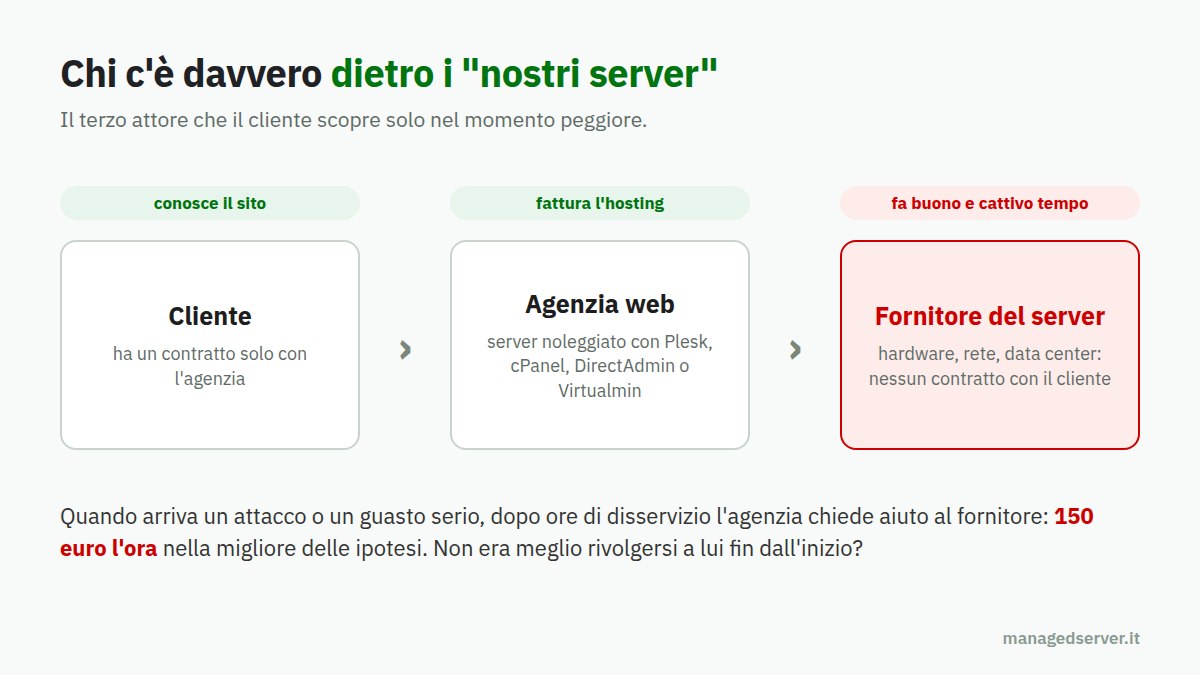
When an agency says "our servers," in the vast majority of cases, it's one or more Dedicated or Virtual Servers rented from a provider, running a general-purpose control panel like Plesk, cPanel, DirectAdmin, or open-source versions like Virtualmin and similar. In the best-case scenario, it's a Dedicated Server reseller with a control panel.
It's a business that can certainly work for the agency: a recurring fee, attractive margins, and the client tied to something else. But it certainly doesn't work for the client, who ends up with a site managed by web developers rather than systems engineers. Panels are useful tools, but they're no substitute for expertise: they make it easy to create a site and database, but they don't make it easy to understand why the database crashes at 9 PM or how to stop an ongoing attack.
And above all, there's one player the client doesn't see: the provider from which the agency rents the servers. He owns the hardware, the network, and the data center. He's the one who really calls the shots. The client has no contract with him, doesn't even know his name, and will only find out about him at the worst possible moment.
What is a monthly routine for a hosting provider
There are scenarios that aren't a daily occurrence for a structured hosting provider, but are monthly. Complex situations that arise without warning and at the most inopportune time:
- volumetric DDoS attacks, which saturate the network and make everything behind the same address unreachable;
- application DDoS attacks, thousands of seemingly legitimate requests that bring PHP and databases to their knees;
- criminal activities that compromise websites, install malware, send spam, or use the server as a base for other attacks;
- extortion demands, with threats of attack or stolen data and the request for payment;
- hardware failures, degrading disks, corrupted databases to be restored as soon as possible.
A provider that's been doing this for years has developed a whole series of countermeasures, procedures, and tools ready to be used when needed: filters, rules, DDoS mitigation systems , log analysis, response playbooks, and people who've seen the same attack dozens of times. Those who build websites and host client sites typically have none of this.
The moment you find out who's behind it
This is how it almost always happens. One of these situations comes up. The sites go down. The agency tries to figure out what's going on, restarts the services, searches Google, posts in groups. Hours pass. Hundreds of customers call, write, complain. Eventually, the agency opens a ticket with the provider from which it rents the servers and requests a paid intervention, at €150 an hour in the best case scenario, when the provider offers this type of assistance.
And it's only then that the client, previously unaware, realizes there was another player behind the agency's hosting, and it was the one calling the shots. At that point, the question arises: wouldn't it have been better to turn to a hosting provider directly from the start?
With a direct supplier, the customer would have had a contract, an SLA, system support, people who know the infrastructure because they built it, and no intermediaries to wait for while the site remains down.
Why It Happens: The Psychology of the Prescriber
If it's so obvious, why do so many companies continue to host their websites at the agency? The answer isn't technical, it's psychological.
The webmaster or agency has already captured your interest and trust. They've supported you throughout the project, understood you, and delivered something you like. From that moment on, they become the prescribers of your technical choices: if they tell you it's best to host with them, you have no reason to doubt them. It's the same mechanism we described when discussing commissions in the hosting world : technical advice and the commercial interests of those providing it become confused.
But you need to be clear about one thing: for a supplier, you're still just a budget item. Except in rare cases of previous relationships, there's no friendship. There may be courtesy, there may be friendliness, there may be an excellent professional relationship. But when it comes to money, ultimately you're just a budget item. And a hosting fee that's profitable for the agency is a budget item the agency has every interest in maintaining, regardless of how well it fits your needs.
The practical consequences
Beyond the risks in emergencies, there are more everyday consequences that we often see when these sites are migrated to our area.
- Total dependence. Domain, DNS, hosting, email, website, and logins are all in the hands of the same person. If the relationship deteriorates, switching providers becomes a daunting task.
- No visibility. The customer doesn't know where the server is, who manages it, whether there are backups and where they are located, or how the mail is configured.
- Shared and crowded servers. Hundreds of different sites, with different plugins and versions, on the same machine: one compromised or attacked site can bring down all the others.
- Updates postponed. Operating systems, PHP, and databases stuck on old versions because “it works, we don't touch anything.”
- Performances never analyzed. When your site is slow, the typical response is to add a caching plugin, not to figure out where you're wasting your time.
Everyone should do their job well
The model that works is simple, and it's the one we see in the best projects. The agency does what it knows how: designs, develops, maintains, and grows the site. The provider does what it knows how: manages the infrastructure, security, backups, monitoring, and emergencies. The client has a direct contract with both, and the two providers collaborate, as should always be the case and as we explained in "Dear Colleagues, Let's Collaborate . "
Some practical rules for those who are choosing:
- Register everything in your name. The domain, DNS, hosting contract, and mailboxes must be in your company's name, with access that you control.
- Ask who really runs the server. Who owns it, where it is located, who intervenes at night, who responds in case of attack.
- Ask for backups. Where are they, how many days do they cover, who restores them and in how much time, and when was the last test done.
- Be wary of those who want to do everything. Website, hosting, email, SEO, social media, privacy consulting, photography: when you see someone trying to do it all, run away.
Conclusions
It's time to see the world of the web for what it is: a collection of different professions, each with its own skills, tools, and responsibilities. Those who create websites do valuable work, and they don't have to be a hosting provider to be a good professional. In fact, the best are those who know where their job ends and who to entrust the rest to.
Hosting your website with the agency that created it might seem convenient on the day of delivery. It's much less so on New Year's Eve, when your website is down, the agency isn't responding, and the actual provider doesn't even know who you are.
At Managed Server, we do this for a living: WordPress hosting , managed dedicated servers , and Linux system support , working side by side every day with the agencies and developers who remain the point of reference for their clients' websites. They build, we ensure that what they've built stays up and running, fast, and secure.

