
Table of contents of the article:
On October 20, 2026, the PHP security team published a rarely seen notice: a special security release, scheduled for Wednesday, October 21, at 2:00 PM UTC (14:00 PM GMT) , to fix two critical vulnerabilities , both with a CVSS v4.0 score of 9.2 . A few hours earlier, some details had leaked online before the embargo ended, and the flaws have been circulating among researchers ever since under the name PHP16Shell.
TurboLab provided a comprehensive report , and the news was picked up by major international news outlets and security firms. In this article, we'll break down what's confirmed, what's not yet confirmed, what to do immediately, and what we're doing.
Updated October 21, 16:00 PM. PHP has published the official advisory and the fixed versions: PHP 8.5.12, 8.4.27, 8.3.36, and 8.2.35 . The two vulnerabilities allow unauthenticated remote code execution, and the attack code is already public: update now.
The official PHP notice
On October 21, the PHP project released versions 8.5.12, 8.4.27, 8.3.36, and 8.2.35 along with a warning with the unmistakable title: Security advisory: Critical remote code execution vulnerabilities, update now . The releases fix two critical vulnerabilities that could allow unauthenticated remote code execution, and all PHP users are urged to update immediately.
Who is at risk?
According to the advisory, all PHP installations that serve web requests are at risk : PHP-FPM, Apache with mod_php, php-cgi, FrankenPHP, and LiteSpeed. The risk is considered highest for mod_php , for which there is a demonstrated exploit where an unauthenticated request can trigger the attack before any application code is executed.
Translation: It doesn't matter how up-to-date WordPress, plugins, or the CMS are. The problem lies in the interpreter that runs them.
The two vulnerabilities
- CVE-2026-109618, code execution via out-of-memory corruption. Memory exhaustion handling can interrupt PHP while the request's internal data is only partially initialized. End-of-request cleanup can then treat that invalid data as if it were valid.
- CVE-2026-109619, Code execution via deprecated global state. Internal state tied to a request can survive after the memory containing it has been freed. A subsequent request handled by the same process can use that state before normal initialization clears it.
The analyses published this morning, which identified the session.upload_progress function, therefore described one of the confirmed paths to the second vulnerability, not the only one.
How to update
- Please upgrade to PHP 8.5.12, 8.4.27, 8.3.36, or 8.2.35, depending on the branch you're using. Windows sources and packages are available on the PHP download page.
- Linux Distributions and LTS Vendors received patches early: check with your vendor for updated packages.
- PHP 8.1 and earlier They no longer receive updates from the PHP project. Some distributions and LTS providers offer ported fixes for older versions; please check with your provider or upgrade to a supported version. Given the severity of the issue, the PHP security team has provided minimal source code fixes for PHP 7.4, 8.0, and 8.1 for those who compile PHP themselves or don't have access to an LTS provider.
- Who uses the rpms.remirepo.net repository?, maintained by volunteers and widely used on Red Hat, AlmaLinux and Rocky Linux, is encouraged by PHP to switch to the distribution's packages or compile from sources in order to be able to update immediately: according to the notice, the repository will not have updates today.
If you can't update right away
The warning is very clear: only updating is a complete solution . The following measures reduce exposure to specific attack paths, but they do not make an installation secure.
For CVE-2026-109618, out-of-memory corruption:
- set up
memory_limit=-1in a way that applications cannot overwrite, for example withphp_admin_valuein the PHP-FPM pool or Apache configuration, and ensure that no pool, folder, or application resets a finite limit. This eliminates controllable failures due to PHP's memory limit, but a lower-level allocation error can still reach the vulnerable path; - set a
post_max_sizeBass: 8M for applications that do not require file uploads, 32M if uploads are necessary, keepingupload_max_filesizeless thanpost_max_size. Also consider web server or proxy level limits on decoded request size, number of fields, multiparts, number of headers and nesting depth, which also apply to requests without aContent-Lengthusable; - Use a container- or cgroup-level memory limit as a barrier to service availability, preferably with a policy that only kills the affected process. No use in its place
RLIMIT_ASoRLIMIT_DATA, which can actually cause vulnerable allocation failure.
For CVE-2026-109619, global status is obsolete:
- set up
session.upload_progress.enabled=0and restart all processes. The setting must be set tophp.ini, in the PHP-FPM pool or server configuration, i.e. where it applies before processing the request: immense withini_set()nor with the files.user.iniBlocks confirmed session-related paths, but not other variants; - su PHP 8.5, setting up
fatal_error_backtraces=0and restart all processes. Only block the confirmed path related to fatal error backtraces; - Remove invalid or deprecated settings applied on a per-request basis that generate diagnostic messages before initialization. Hide them with
error_reporting,display_errorsor with the operator@it's not necessary; - fix fatal errors and execution timeouts that an attacker can cause, including those in callbacks, upload and import processing, and cleanup operations.
Exploit already in circulation
Already on the morning of October 21st, before the official release, demo code capable of exploiting the vulnerabilities had appeared online, reported by several cybersecurity outlets. The official announcement confirms the existence of a proven exploit. With the fixes now public, comparing the before-and-after code becomes even easier: it's reasonable to expect large-scale automated scans and attacks in the coming hours and days.
The following sections describe the situation on the morning of October 21, before the official announcement, and remain as a chronicle of how the story developed.
What was confirmed before the release
There's only one official source: the notice published on the PHP website. It says exactly this:
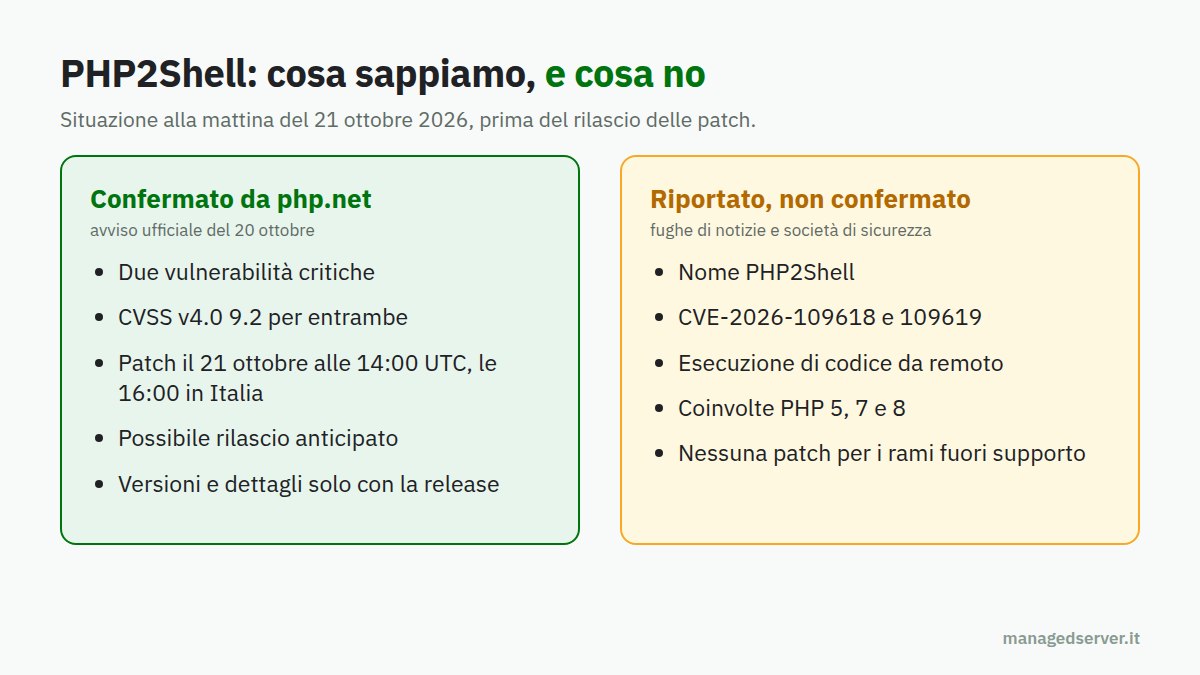
- exist two critical vulnerabilities, both evaluated 9.2 of 10 with the CVSS v4.0 system;
- the release that fixes them is scheduled for October 21, 2026, at 14:00 PM UTC;
- the team reserves the right to bring forward the release if details become public or if evidence of active exploitation emerges;
- technical details, affected versions and corrected versions will only be published together with the release;
- All PHP users are invited to get ready now to update as soon as patches are available.
Such a preemptive warning, with a release date and time announced in advance, is something the PHP project reserves for truly serious cases. It's a signal that should be taken seriously.
What was said before the release
A lot of information has accumulated around the official announcement, coming from leaks and security firms. These are useful for understanding the scope of the problem, but they should be read for what they are: unverified predictions from the PHP project.
- The name PHP2Shell It is circulating among researchers, but does not appear in the official press release.
- The identifiers CVE-2026-109618 and CVE-2026-109619 They have been reserved, but currently have no public description, and PHP's release does not mention them.
- The nature of the flaws: According to watchTowr, these are remote code execution (RCE) vulnerabilities, meaning an attacker can execute commands on the server. The company claims to have reproduced one of the two vulnerabilities, without disclosing details.
- The versions involved: This refers to PHP 5, 7, and 8. If true, this would affect virtually every version of PHP in use over the past fifteen years.
- The risk of obsolete versions: Patches should only be available for still-supported branches of PHP 8. Users of PHP 5, PHP 7, or out-of-support versions of PHP 8 may be left without an official fix.
- The score: Some sources talk about CVSS 10, against the 9.2 declared by PHP.
When this article was first published, there were no active exploits or public exploits. Within a few hours, the situation changed: as explained above, public demo code appeared. And several analysts expect mass automated attacks very soon after the patches are released: once the fixes are public, comparing them with previous code allows them to understand the problem and build an attack very quickly.
Because it concerns practically everyone
If the vulnerability is in the PHP engine and not in a single application, the scope is enormous. PHP powers WordPress, WooCommerce, PrestaShop, Magento, Joomla, Drupal, OpenCart, numerous management software, user areas, control panels like cPanel and Plesk, and a host of software that doesn't even declare it uses it.
It doesn't matter how updated WordPress is or how well-maintained the plugins are: if the problem is in the interpreter that runs them, protection must come from updating PHP itself. And this is an update that, for most sites, depends not on the site administrator but on the server administrator.
The most sensitive case is that of forgotten servers: old installations with PHP 5 or PHP 7, sites never migrated, shared hosting no longer maintained, test environments exposed to the Internet. These are precisely the ones that risk never receiving an official fix, and will be the first targets of automated attacks.
What to do, besides updating
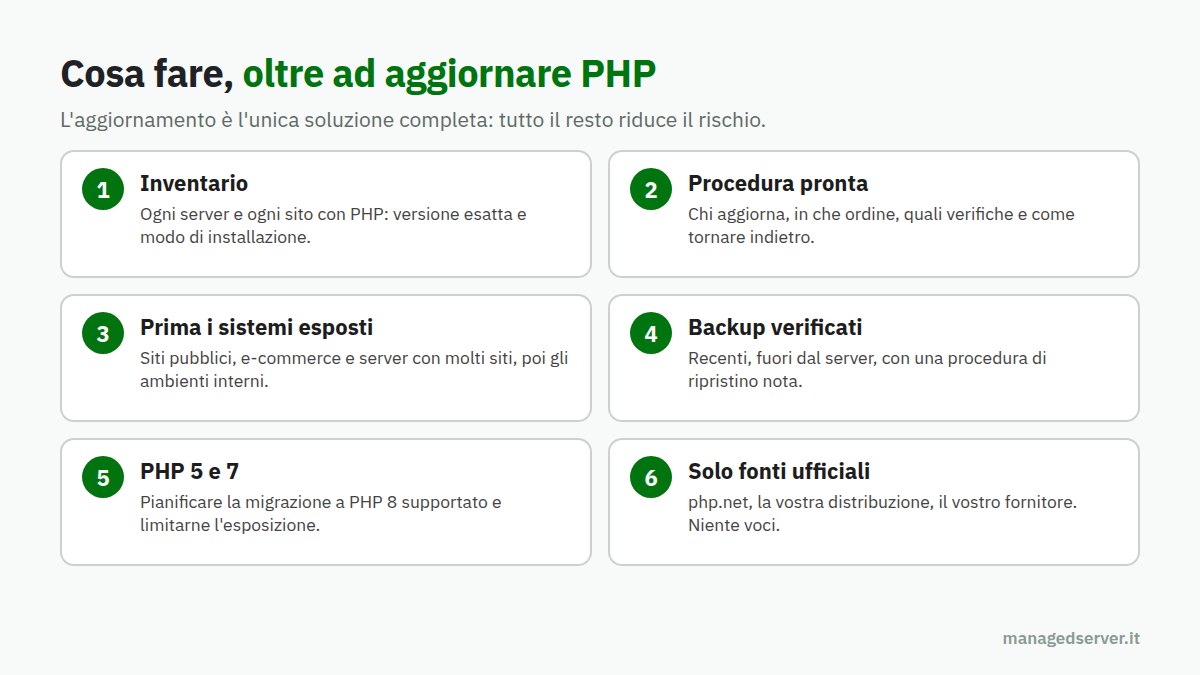
Updating remains the top priority. There are a few things you should do right away.
- Take inventory. Record every server and site using PHP, with the exact version and how it is installed: distribution packages, external repositories, control panels, containers, hand-compiled versions.
- Prepare the update procedure. Who updates, on which servers, in what order, with what post-update checks, and what rollback plan in case of problems.
- Prioritize exposed systems. First, public sites, e-commerce sites and servers that host many sites; then internal environments.
- Check your backups. That they exist, that they are recent, that they are stored off the server and that we know how to restore them.
- Deal with outdated versions. If you have sites running PHP 5 or PHP 7, now's the time to plan your migration to a supported version of PHP 8. In the meantime, consider limiting your exposure.
- Follow official sources only. PHP's announcement, security advisories from your Linux distribution, and your vendor. Don't act on rumors or alleged exploits posted on social media.
After the release, in addition to the update, it is a good idea to keep an eye out for signs of a possible compromise: system processes started by PHP processes, new files in the site folder, users or scheduled tasks that were never created.
What we are doing in Managed Server
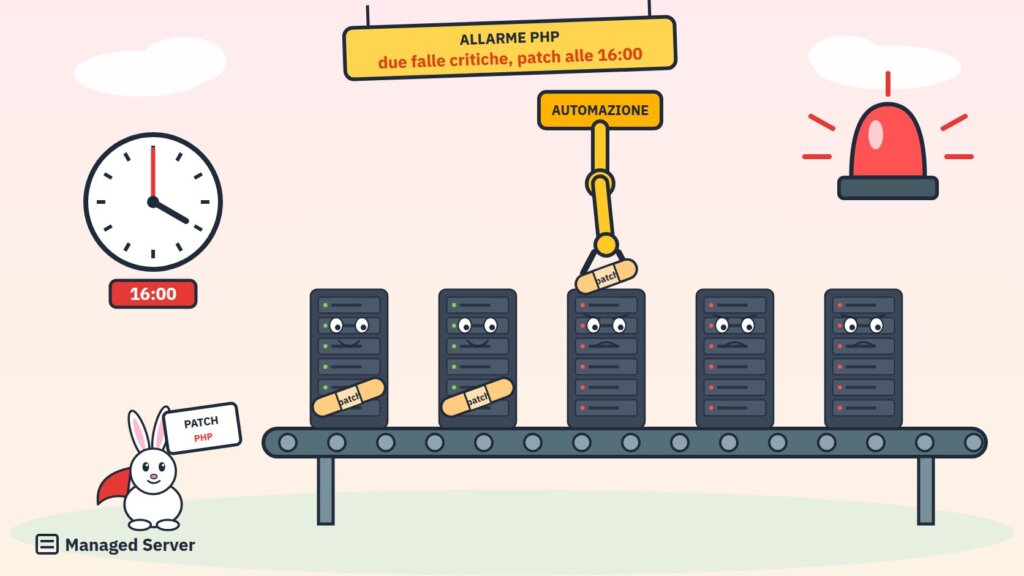
We're already working with Ansible , the automation tool we use to manage system configuration, to patch all the systems we manage. The playbooks are ready to deploy the correct PHP versions to all servers in a coordinated manner as soon as they're available, without having to intervene machine by machine.
It's precisely in situations like this that the difference between a structured and manually managed infrastructure becomes clear: when a critical vulnerability affects a component present everywhere, the time between the release of the patch and the update of the last server is what separates a protected system from one exposed to automated attacks.
For customers with unsupported PHP versions, we will evaluate on a case-by-case basis what actions to take and migrate to a supported PHP 8 branch.
If your site isn't hosted by us and you're not sure who will be updating PHP on your server, and when, it's time to ask. If you need help with inventory, updates, or migration from outdated versions, our Linux system support is available.
Updates
The PHP project has published the official release and announcement, which are included at the beginning. We will update this article with any new official information.
Sources
- PHP, “Security advisory: Critical remote code execution vulnerabilities, update now” dated October 21, 2026
- PHP Announces "Upcoming Critical PHP Security Release" for October 20, 2026
- TurboLab, "PHP Red Alert: Two Critical Vulnerabilities"
- BleepingComputer, PHP team's warning, and watchTowr's statements
- Cyber Security News, public proof of concept for PHP2Shell
- PentestIT: What we know about CVE-2026-109618 and CVE-2026-109619
- Huntress, information status and operational recommendations

