
Table of contents of the article:
It's not every day you read a headline like this on a company blog. We're used to measured press releases, phrases polished by the marketing department, adjectives chosen to avoid offending anyone. Not this time. This time, we've decided to use the words we use among ourselves, in the office, in front of a computer, when things get serious. And the nautical proverb that gives the title to this article is precisely the phrase that came to mind in recent days, observing how the hosting industry has responded to one of the most serious security crises in recent years.
For years, in the Italian market, hosting providers have been lumped together. On one side, there are companies that design infrastructure, write code, study problems in detail, and solve them. On the other, there's an army of makeshift resellers who simply buy a server, install a control panel like Plesk, cPanel, or DirectAdmin, list their services on a showcase website, and call themselves a "provider." To the end customer, who lacks the tools to distinguish one from the other, they're all the same: one name, one price, an offer that says "SSD" and "24/7 support."
As long as the sea is calm, in fact, the difference is invisible. WordPress runs pretty much everywhere, anyone can install an SSL certificate with a click, and even the control panel automatically performs nightly backups. Everyone seems like a sailor.
Then comes the storm. And the storm, at the end of October 2026, has a specific name.
The perfect storm: two 9.2 CVEs
On October 21, 2026, the PHP project fixed two vulnerabilities, CVE-2026-109618 and CVE-2026-109619 , dubbed PHP2Shell online . We reported on them the same day : two flaws with a CVSS severity score of 9.2 , exploitable remotely and without authentication, affecting any PHP installation that serves web requests. Simply put: an attacker, without an account, can execute code on the server. And the attack code was already circulating before the patches were made public.
When vulnerabilities like this come out, there's not much to discuss. You don't hold meetings, you don't wait until Monday, you don't send out a newsletter. You just update. All hosting providers with even a modicum of self-respect, and even a modicum of respect for their customers, have updated PHP to the correct versions (8.5.12, 8.4.27, 8.3.36, and 8.2.35) within half an hour of the release. We did this across our entire infrastructure. So far, nothing special: it's the bare minimum.
The real problem is another, and it is what separates those who know how to navigate from those who have simply bought the captain's hat.
“We only patch from 8.2 onwards”
The PHP project has been very clear, as it should be: supported versions are those from 8.2 onwards, and only those receive official fixes. For older versions, outside of their lifecycle, the security team has made a minimal source code fix available, specifically designed for those who can't immediately update.
At that point, someone who has been doing this job in the Linux world for twenty years stepped in. Remi Collet , the maintainer of the Remi repository, familiar to anyone working with Red Hat, AlmaLinux, or Rocky Linux, ported the fix to the still widely used versions: PHP 8.1, 8.0, and 7.4, with ready-to-use packages. We talked about it in a dedicated article . A huge job, done in just a few days, for which the community should be grateful.
And under 7.4? That's where things get murky. For 7.3 and 7.2, the fix exists in the sources, but there are no ready-made packages for current enterprise distributions like AlmaLinux 9. For PHP 7.1, 7.0, and 5.6, however, there's absolutely nothing : no official patches, no packages, no repositories. A void.
And this is where the hosting world split in two.
The announced surrender
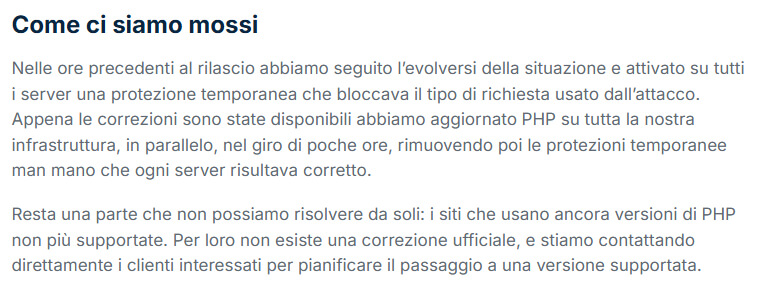
In the following days, we read press releases from hosting companies, including some very well-known ones, who publicly stated what many were ultimately thinking: there was no solution for previous versions. We had already contacted customers to encourage them to upgrade to a secure version of PHP, as you can see, for example, in the screenshot below. Not that it was the only one; in fact, all of them took this approach.
Said like that, it seems like a responsible statement. Prudent, even. In reality, it's a surrender. It's the captain who, at the first high wave, announces to the passengers that the ship isn't equipped for rough seas and that they should find another boat. Quickly, if possible, and alone.
Let's be clear: upgrading PHP is always the right path in the long run. We've been saying it for years, and we'll continue to say it. But there's a huge difference between advising a customer to plan a migration and telling them, in the midst of an emergency, that the problem is theirs.
The real world isn't just WordPress
Anyone who manages a few hundred WordPress sites with a theme purchased from a marketplace might think that updating PHP is a simple matter. You change the version from the dashboard, cross your fingers, and at most deactivate a plugin that's giving you an error. That's it.
But serious hosting isn't just about WordPress. It's about companies that produce:
- management games developed ten or fifteen years ago, of which no one has the original developer anymore;
- e-commerce on outdated versions of Magento, PrestaShop, or proprietary solutions, with deep customizations that don't work on new versions;
- portals, intranets, and reserved areas integrated with external systems (ERP, CRM, warehouse management, payment systems) that “work and nobody wants to touch”;
- Frameworks and libraries that no longer exist, written for PHP 5.6 or 7.1 and never ported forward.
For these projects, saying "upgrade to at least 7.4" isn't advice: it's a judgment. Because anyone who truly knows PHP knows exactly what happens when you move a legacy application from PHP 5.6 to PHP 7.4 or 8: removed functions, missing extensions (mysql, mcrypt, ereg), changed behavior, errors that were once silent warnings now stop everything. The software stops working. Not maybe: definitely.
And porting such an application to a recent version of PHP isn't done in an afternoon. It requires weeks, sometimes months of work: code analysis, fixes, testing, and final inspection. Meanwhile, the site must stay online, orders must continue to arrive, and the management system must continue to generate billing. There's no company that can afford to shut down everything for a month because its hosting provider doesn't know how to protect it.
Telling a customer in that situation, "There's no solution for your version, please update," means burdening them with a problem they can't resolve within the timeframe required by the emergency. It's convenient for the person who says it. It's disastrous for the person who receives it.
What we did
We chose the opposite path. Instead of saying it was impossible, we rolled up our sleeves and did it.
We took the fix published for PHP 7.4 and manually ported it to previous versions : PHP 7.1, PHP 7.0, and PHP 5.6. It's not a matter of copying and pasting a patch and hoping it will work. The PHP engine changes dramatically between versions: different data structures, different memory management, entire parts of the engine that exist in one version but not in another. For each version, we had to understand exactly what the original patch fixes, find the equivalent points in the old code, and rewrite the changes to match the architecture of that specific release.
For PHP 7.1 and 7.0, it was a meticulous porting, line by line. For PHP 5.6, which has a completely different engine than the 7 versions, the fix was rewritten from scratch , following the same logic: the same protection principle, implemented on the internal structures of 5.6. For PHP 7.3 and 7.2, we used the fix already available in the source code, rebuilding the packages for the systems we work on, since ready-made packages didn't exist.
Then we rebuilt everything. Not just a single PHP binary thrown together, but the entire ecosystem for each version, just as our customers actually use it: PHP-FPM, all the standard extensions, drivers for MySQL, PostgreSQL, and other databases, and the extensions that make a difference in real-world projects, like Imagick for image processing, Redis, APCu, igbinary, msgpack, zip, mcrypt, and the old mysql extension for older software. All this for modern enterprise distributions, where these PHP versions no longer exist officially.
We tested each version with the thousands of automated tests in the PHP project, verified that each extension loads and works, tested image processing with GD and ImageMagick, encrypted connections, sessions, and databases. And of course, we verified that the fix does exactly what it's supposed to do, under the same conditions an attacker would attempt to exploit the vulnerability.
Finally, we made everything available in an internal, digitally signed repository for our systems and customers. We are now able to securely offer PHP 7.3, 7.2, 7.1, 7.0, and 5.6 fixed for CVE-2026-109618 and CVE-2026-109619. This work can also be extended to PHP 5.4 and 5.5 for those who need it.
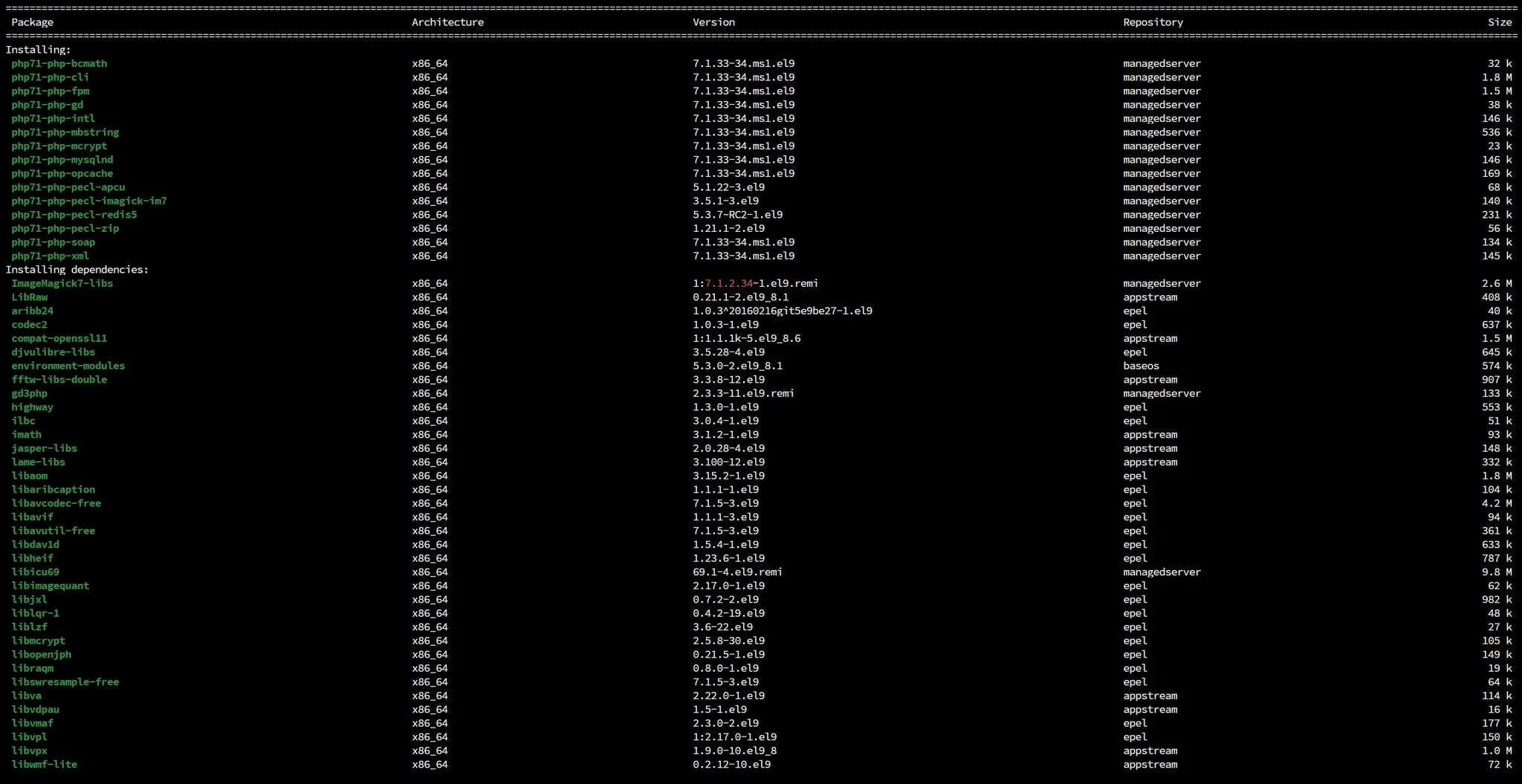
We're deliberately not going into the technical details of how we did it. Not out of vanity, but because know-how is precisely what sets us apart from the rest, and we have no intention of giving anyone the work of days and nights spent coding the PHP engine.
We want to be honest about one thing, though, because seriousness also begins here: the fix we've applied follows the same logic as the official one, which, by choice of PHP maintainers, is a minimal mitigation designed for out-of-support versions. It protects against the vulnerability; it doesn't transform PHP 5.6 into PHP 8.4. It remains a bridge, a solid one, that allows you to navigate the emergency and calmly plan, and with the right timing, the migration to a supported version. Without panic, without downed sites, without rushed porting that creates more problems than they solve.
Because it's not for everyone
Some might think: if you did it, anyone can do it. In theory, yes. But in practice, we're the only ones who did it, and that's what matters. Getting there requires a combination of skills that are rarely found under one roof, much less those of someone selling hosting for five euros a month.
You need to know how to read and write C at the system level, because PHP is written in C and the vulnerability lies deep within its engine, not in a script. You need to know PHP's internal architecture and how it has changed over ten years of versions, because a bad change to a single line in that part of the code doesn't produce an obvious error: it produces a PHP that appears to work, but then, under load, in production, behaves unpredictably.
You need to have a thorough understanding of enterprise distribution packaging, because a 2016 version of PHP won't compile and install as is on a 2026 operating system: the system libraries have changed, some no longer exist, others have changed interfaces. You need to know how to manage dependencies, extensions, coexisting multiple versions on the same server, package signing, and secure distribution.
And above all, you need a method: verify everything, take nothing for granted, compare the result with the original, test each package as a real client would use it before it reaches a production server. The method isn't improvised on the night of an emergency. It's built over years of work on real systems, with real clients and real problems.
It's no coincidence that, in recent weeks, there's been almost complete silence regarding PHP 7.1, 7.0, and 5.6. Not because the problem didn't exist: because almost no one was able to address it.
Competence is seen when others wait
The issue isn't the single patch. The issue is the attitude.
When a serious problem arises, most hosting providers do just one thing: they wait. They wait for the panel manufacturer to release an update, for the vendor to release a patch, for someone else, somewhere in the world, to fix the problem for them. If a solution arrives, they install it and send an email to customers saying "our team promptly fixed it." If the solution doesn't arrive, they send an email to customers saying there's nothing they can do.
We don't wait. This isn't the first time we've shown it, and it won't be the last.
We did it with the NGINX bug in HTTP/3 which prevented the valorization of the variable $http_host QUIC connections: a problem that was causing configurations, redirects, and applications to go haywire, and that everyone around the world simply reported or circumvented with some workaround. We analyzed it, found the cause in the NGINX code, and fixed it independently, submitting the patch to the community.
We did it with WAF4NGINX , the web application firewall we developed internally to defend our clients' websites from waves of bots masquerading as legitimate browsers: requests that perfectly mimic Chrome, Firefox, or Safari, which traditional systems can't distinguish from human traffic. With WAF4NGINX, we filter them with surgical precision, without any visual intrusion for real users: no waiting pages, no checkboxes to check, no browser verification banners like those we've become accustomed to with solutions like Cloudflare, which with every check cause a visitor or conversion to be lost. Anyone who wants to understand how we think about these issues can read how effective anti-bot systems are built.
They are different stories with a common thread: when the problem is difficult and no one has the solution ready, we build it.
The showdown
Today, many users with sites running outdated PHP versions will have to face reality. They'll discover that their provider, the one with the great deals and the convenient control panel, when faced with the first real problem, could only offer one piece of advice: update. They'll discover that behind the brand, the glossy website, and the 24/7 support, there was no one capable of tweaking the engine. They'll discover, the hard way, the difference between a web space reseller and a systems engineering firm.
For our clients, however, this week can be just like any other. The PHP 7.1 website continues to serve pages, the PHP 5.6 management system continues to generate revenue, and the e-commerce site continues to receive orders. No one has to rewrite their software overnight, no one has to rush to find a developer, no one has to choose between being vulnerable and being shut down. The fix is installed on the server like a normal system update, in the same PHP version already in use, without touching a single line of the application code. And the migration to a modern version of PHP, which remains the goal, is planned together with the right timing, not with panic.
And let's be clear: it's not a sin to not be able to do everything. No one can have universal skills. The sin, if anything, is being unwilling to step out of your comfort zone and abandoning decades-old practices in systems engineering, such as backporting security patches.
This is exactly what Red Hat routinely does when, for example, it adapts a fix developed for a vulnerability discovered in a recent Linux kernel, belonging to the 6.x branch, to a much older kernel, such as one from the 4.x branch, without necessarily updating the entire system to a new version.
The fact that many hosting providers and system administrators don't do it today doesn't mean it's technically impossible. Rather, it means that a practice has gradually consolidated whereby what is no longer done by the majority ends up being considered useless, impractical, or even impossible.
A sort of "misery loves company" applied to systems engineering, where the limitations of one's own skills are mistaken for the limitations of technology and where the habit of not doing something becomes, paradoxically, the justification for continuing not to do it.
But the technical reality, as we've demonstrated, is quite different. Backporting security patches is possible; it's a well-established practice in the software industry and, when done correctly and subjected to the necessary testing, allows even legacy components to remain secure.
The difference is that we know how to do it. And we do it.
For our part, we've repeatedly demonstrated that we have much more to offer than just basic hosting. Virtually everyone can offer decent-performance hosting these days: servers are inexpensive, the panels do almost everything themselves, and artificial intelligence writes configurations for those who don't know how to write them. What can't be bought, installed, or improvised is expertise: the ability to deeply understand a problem and solve it when no one else has.
A clear line
This story affected every hosting provider in the world, without exception. The same problem, at the same time, for everyone. And that's precisely why it was so revealing: there were no excuses, no starting advantages, no easier or more difficult clients. There was only one question, the same for everyone: what now, for those left behind?
The response drew a clear line.
On the one hand, there are those who have continued to offer their customers the service they needed, securing vulnerable versions with their own work and expertise, and giving them time to calmly plan for the future.
On the other hand, there are those who, not knowing how to do it, simply talk to the customer, urging them to port to a secure version, as if that were always a viable, easy, and quick path. As if it were just a click away.
If you have a website or application running PHP 7.3, 7.2, 7.1, 7.0, or 5.6, and your provider has told you there's no solution, know that's not true. The solution exists; we've already built it and use it every day. Find details about our PHP security patch backporting service , and if you'd like to discuss it, contact us . We'll analyze your situation and clearly explain what can be done, how long it will take, and the limitations.
Because when the sea is calm, every asshole is a sailor. But it's in the storm that you see who truly knows how to steer.

